One of my goals this year, as I mentioned in my last post, is to really focus on my Mandarin skills. I’m planning to take the HSK before we leave next summer, and I’d really like to do well. The HSK is a Chinese proficiency test for foreigners learning the language. The highest score is a 6, which would demonstrate “a learner who can easily understand any information in Chinese and is capable of smoothly expressing themselves in written or oral form”. I’m aiming for a 3 (haha!), and since I’m likely going on this journey alone (Tucker really has no interest), I’d like to at least share a little bit about what makes Chinese such a difficult language to learn.
First off, there is no alphabet. For example, 没 (meaning “not”) is pronounced méi, while 设 (meaning “establish”) is pronounced shè. They look similar, but sound nothing alike. Similarly, 香蕉 “banana” and 相交“to intersect” are pronounced the exact same way (xiāngjiāo). There is clearly no “sounding it out”, which is what frustrates Tucker to no end! Okay, you think, that’s not such a big deal. You just have to remember the characters as if they were words. Unfortunately that means there are over 50,000 to memorize. Also, each word is not one character; they are some combination of characters, which means not only do you have to know the characters in a particular word, but you have to know the order: 蜜蜂 (mìfēng) means “bee”, but 蜂蜜 (fēngmì) means “honey”. No, I don’t want any bees on my toast, thanks.
43 strokes for 1 “biang”!
However, recognizing the characters and knowing their order isn’t enough either because if you want to learn how to say them or find more information about them, in, say, a dictionary, you must be able to write them. Chinese has a very particular stroke order, which refers to the order and direction in which you write the characters. This is how Chinese dictionaries are often organized (even online), and if you don’t obey the proper stroke order, most online translators can’t seem to figure out what you’re going for. If you’re someone who starts your English letters from the bottom up, good luck! Even if ignoring the correct stroke order wasn’t an issue, most Chinese characters an average of between 7 and 12 strokes. The most in any single English letter? 4. My characteristically neat handwriting has never been tested in such a way!
Luckily, a group of linguists realized just how difficult the Chinese characters were for people coming from languages with alphabets, so they created one of my favorite things in the world: pinyin. Pinyin is a system of phonetic representation of Mandarin. It utilizes the Latin script (like English), and allows us, alphabet freaks, to quickly (and more naturally) read the pronunciation of a word. Sometimes a word will be presented with both the characters and the pinyin, such as: “卫生间 wèishēngjiān” (which means “bathroom” by the way – very useful!). This double representation is why I often say learning Mandarin is like learning two languages, you really have to know the characters and the pinyin! It is super helpful for us when we see both pieces of information together though. Then we know both how to say the new word and how to write it. Unfortunately, we rarely get that; usually it’s one or the other, not both. Sometimes there is a translation instead of the pinyin, but I’m not sure that is always so helpful…
This one is actually pretty great!
Another problem we often encounter with pinyin is that it is more often than not missing the diacritic marks. Those marks represent the four tones of Mandarin, and are essential in its pronunciation. Unlike in English, changing the pitch of your voice while speaking Chinese can actually change the words you are saying. The pronunciation of mā (“mom”), má (“hemp”), mǎ (“horse”), and mà (“to scold”) only differs in tone. Unfortunately for lazy, toneless English speakers (like me), this makes it really hard for native Mandarin speakers to understand exactly what we’re saying. We try for “mom” and end up with “horse”, something which I hope has been more entertaining than irritating for them!
Ultimately, we struggle in reading, writing, speaking, and, with the various Chinese dialects, listening is a challenge as well. However, if you ask me whether I find Chinese or Polish more difficult to learn, I’ll say Polish every time. Chinese and English grammar actually have a lot in common. Our word order for example, is pretty similar. Chinese also has no articles or gender to worry about (two language features that I learned to despise very early on in French, and again with Polish). Perhaps most interestingly, unlike Polish and English, Mandarin is an isolating language, which means that the verbs are not inflected or changed for things like tense or aspect. So while in Polish I had to work really hard to conjugate and decline every word in a sentence before I could put them into a coherent thought, in Chinese I can just string them all together, adding new words when a change in tense or number is needed. For my brain, that is so much easier to do!
There is also something so intuitive about Chinese. Although my Chinese teachers tell me I should NEVER separate the characters of various words, it’s hard not to, and honestly that’s what helps me remember the vocabulary half the time in the first place! Here are some gems we’ve discovered (so far) in the Chinese lexicon:
Train = Fire + Car
Balloon = Air + Ball
Cellphone = Hand + Machine
Turkey = Fire + Chicken
Menu = Food + Sheet
Patriotism = Love + Country
Delicious = Good + Eat/Drink
Alright now! Who’s ready to learn this with me?! Chinese is definitely a language on the rise as far as power and prestige go. Much like what happened to English in the 1700s, increases in immigration, tourism, and business are spreading Chinese to all parts of the globe. In Australia, I was surprised and delighted to find Mandarin on most signage, and, even in Georgia/Florida (quite far away from China), maps and other tourist information can often be found in Mandarin. Some linguists refer to Chinese as the language of the future, and while right now it’s more painfully in my present, I hope to keep it around for my future as well! Wish me luck! 祝我好运!
We’re back! Back in China, back in Hefei, back at Anhui University, and I couldn’t be happier. I’m so thankful I was given the opportunity to extend my fellowship until June 2019, and I definitely plan to make the most of it! In fact, I thought I’d even share a little bit about my plans for the next ten months, partially in the hope that putting them in writing will make them come true and partially so that when I look back I can justify my exhaustion!
Back with some Beijing beers
All the EAP Fellows’ locations
Workshop in Beijing
First, I plan to do my job, of course. Much like last year, my job consists of both teaching and teacher-training. I’ll be teaching courses like Critical Thinking and Writing, Public Speaking and Debate, and English Stylistics to undergraduates at Anhui University. I’ll also be working with my colleagues at AHU to coordinate the English Corner, help coach the student representatives for various national competitions, and ultimately join in whenever and wherever my help is needed. This semester I have an even larger group of students, but I’m super excited to get back into teaching! Now that I have a year’s worth of experience teaching at Anda, I’m ready to try out a few new ideas as well – I hope they’re ready! In addition my duties at the university, this year I’ve also been made a “Fellow Coordinator”, which means that I get to help the new Fellows ease into their China/fellowship lives and help organize and relay various outreach projects within China/Mongolia.
Some of last year’s students
Some of my amazing colleagues
I also hope to go a bit beyond just doing my job and leave something that lasts within the program as well as at Anhui University. I’m dedicated to making as many teacher-to-teacher connections as possible, so that when I leave, there will still be a clear link for sharing ideas, resources, and information. I’m working on creating an online Anhui English Teachers’ group as well as organizing a province-wide conference, where teachers can get together and build lasting relationships in addition to working on their professional development. I’m the only Fellow in my province, so I feel a certain responsibility to make sure I share everything I have with my fellow Anhui teachers. I’m really hoping to create as many opportunities for them as possible, which will hopefully mean a lot of collaboration throughout the year.
It never gets old!
Additionally, I hope to see more of China. If you know me, you know I like new places, and China is full of new places! Tucker and I are already planning several trips throughout the next year (some work-related, others just for fun), but all are very special to me because it’s usually during these trips that I can relax and remember the “cultural exchange” aspect of my fellowship. As far as in-country travel goes, we’ve made a list and hope to visit the cities of Chengdu, Chongqing, Guilin, Qingdao, Macau, and Xining (and more if we possibly can!). Of course, while we’re still in East Asia, there are a few out-of-country destinations I’m hoping to visit as well, starting with a trip to the Philippines in January! :)
More than just travel though, I haven’t lost sight of the fact that I’m living immersed in such an interesting and vast culture! This year there are many ways I’m hoping to experience more of what China has to offer, such as by joining AHU’s badminton team, attending a Chinese opera, learning to make dumplings, volunteering at local animal shelter, and continuing to explore life in our home city. We’ve already made some amazing, lifelong friends, and I want to take this year to really enjoy our time with them, learning and doing all sorts of new things. I’m also still diligently working on my Mandarin skills with the hope of taking the HSK before we leave – one of my more lofty goals, but we’ll see how it goes!
AHU’s 90th Birthday Celebration
Badminton Team
Finally, and rather importantly, I hope to spend some time planning for the future. Tucker and I have decided to move to a new place after this fellowship year is up, but we haven’t fully decided on where. Technically it’s Tucker’s turn to decide, so he’s already working on updating his resume and hunting down our next opportunity. Of course, I’ll soon have to join him in some of the mundane prepping-to-move tasks, but for now, I’m just focusing on not letting the time slip by. We have so much still to do in China, and I’m beyond excited for it all! Here’s to a successful round two!
Tucker and I eased our way back into Western culture this summer by spending three weeks in Australia followed by almost a month back in the States, and while we happily gorged ourselves on some of our favorite food and drinks, we also noticed some distinct changes in our behavior and perspectives this time around. This phenomenon is typically called reverse culture shock (when you return to your home culture after getting used to a new one), and although we had actually experienced this a bit in the past, this time I was determined to not only experience it but also take note of what things stuck out to us as clear effects of living immersed in a different way of life. As usual, in my head I’ve grouped these things in some arbitrary way in order to more clearly share them, and the three main areas of change I’ve come up with regarded: our eating habits, our annoyance at inefficiencies, and a shift in our manners.
Those tacos tho…
Eating Habits: One large area of difference between American and Chinese culture lies in the food and eating. Upon our return to the US we realized there are a few things that we found it hard to get used to again when it comes to food and drink. Ice in water, for example, is way too cold, and it feels like you get less water (ugh, waiting for the ice to melt – who has time for that?). Another thing we immediately missed upon ordering in an American restaurant was that we didn’t order and eat together. It’s sort of an every person for themselves situation, which now feels a little lonely and much more complicated when the bill comes. Tucker also realized he had picked up some Chinese habits when we were out to eat in Australia one night. In the middle of dinner, he started putting his discarded food items on the table rather than in a napkin or on the edge of his plate. I laughed, knowing his reasoning was because that’s what we do in China, but I’m sure the Aussie waitress was thinking, “what is wrong with that guy!”
Why no WeChat Pay?
Annoying Inefficiencies: Another somewhat general category I identified had to do with the speed/way some things are done in the US. Maybe we wouldn’t have ever noticed if we didn’t spend a year in China, but there were some really obvious points of frustration for us upon our return. First, having to pay with a credit card felt as bad as standing there and writing a check. It’s so much slower than the simple scan of a QR code! We were also surprised at how inconvenient it was to have to drive everywhere. Traffic became much more irritating, someone had to shoulder the responsibility of driving, and without practice, we found that we even forget to monitor the gas situation! The third inefficiency that really grated on our nerves almost as soon as we got back was the ineptitude and inefficiency of lines. Say what you will about the crowds in China, but this place knows how to move people! We waited in much shorter lines in the US for much more time than it would have taken in China. At one point, I was also reminded that Americans are not quite as independent as I had previously thought because the airport staff in multiple US cities chose to herd every single individual into the designated waiting areas (slowly and somewhat apathetically) rather than just letting the masses fill in the available spaces naturally.
Even more difficult when on the wrong side of the road!Definitely an American…
Forgetting Our Manners: The last bit of reverse culture shock we noticed revolved around our manners. There were several instances where we completely missed our public duty of saying “bless you” because in China (like many other cultures) it’s a bit rude to comment on bodily functions. I was also caught a few times using language in public that perhaps I wouldn’t have used in the same situation a year ago…it’s amazing how being surrounded by people who don’t understand you can desensitize you to that sort of thing! (To the lady I startled in Target with my English swear words, I’m so sorry! And to the people I perhaps gave too much information to on the flight home – sorry again!) Finally, the last difference that completely took me by surprise was the choice of small talk topics. In China we pretty much stay on subjects like family, hometowns, vacations, etc., but immediately when surrounded by those heading back to the US, it was back to politics, the news, and lots of really direct questions that after a year of light, indirect conversation felt super personal and sometimes rude.
Here’s to more Chinese adventures!
Of course, now that we’re back in China I suppose we’re undergoing reverse, reverse culture shock (like forgetting to carry toilet paper with me everywhere I go and ignoring the slight hand cramp I have after using chopsticks for the first time in months), but overall the more we go back and forth, the more I notice about all the cultures with which I’m familiar. It’s a huge part of why I prefer living abroad to traveling abroad – there’s so much deeper we can go when learning about ourselves and all the amazing customs in the world, and lucky me, I get to do it all again with another year immersed in the Far East!
So, we’re getting close to finishing up our first year in China, and I think it’s about time to share some of our funny little mishaps and the lessons we’ve learned from them because if I’m taking anything home with me from China, it’s definitely the stories! Enjoy:
At least we had already finished our dinner!
Lessons in Flexibility: Ambiguity and flexibility are a way of life when living abroad. There are so many things that happen around us that we can’t explain, and without command of the local language, what can we do but accept them and move on? Usually it’s just something small that completely confuses us, but also makes us laugh in our ignorance. One such example of this happened when my parents were visiting. We were on a train from Huangshan to Hefei, minding our own business, snacking and playing cards when one of the train attendants stood beside our row and asked us to get out of our seats. Tucker and I have been on a lot of trains in China and had never experienced anything like this before, so we were slightly confused…but we did what they asked. We got up, grabbed all of our belongings, stood in the aisle and watched them switch the seats around, so that they were facing the opposite direction. We sat back down and watched them go row by row, asking everyone to do the same. We thought it was very odd to displace everyone for a little reorganizing; however, we soon realized that at the next station the train would be changing tracks and directions. They wanted everyone to be facing forward for the next leg of the trip, perhaps to ward against any bouts of motion sickness. For us, it was just another go-with-the-flow moment that had us all super confused at the time!
Teriyaki chicken floss pizza topped with dried seaweed – I just can’t!
Food is another area where I have had to become pretty flexible. Picky eaters don’t really exist in China, so I’ve been working on my acceptance of various foods (but also on my language skills because there are some things that I just can’t bring myself to try!) However, sometimes the flexibility stems not from the food itself but from my ability (or inability) to successfully da bao. Da bao is essentially “take out” and is very useful on my way home from work, but sometimes I run into issues. One evening on my way home, I stopped at one of the campus canteens to pick up dinner for Tucker and myself. I ordered two noodle dishes for us, but when I was asked about the sides, I mistakenly ordered one bowl of rice instead of two. No big deal, they just put both meals into one container and on top of it, the one bowl of rice. I was a little annoyed with myself for the language mistake, so as I started to bike home with the to-go bag hanging from my handlebars, my mind was elsewhere. Unfortunately, my inattention and a plastic bag that wasn’t quite as strong as I thought led to a slight mishap. I hit a somewhat large bump in the road, and the food hit the ground. The one bowl of rice I had been worried about became one pile of rice, and we ended up having leftovers for dinner instead. Oops. The good news is a couple of students got ringside seats to my little comedy sketch as they sat on the curb right in front of the scene!
Lessons in Safety: Safety in China is a bit different than in the US. There isn’t a litigation mindset here, so it’s pretty much fend for yourself, and if you’re dumb enough to try it, then you deserve any accidents that come your way. For the most part, I have no issue with the safety standards because I typically walk a pretty safe line, no dangling from balconies or standing on ottomans on chairs on tables for me – events we have, indeed, witnessed from our apartment. However, the driving here does scare me a bit. One time on a bus from Hefei to Sanhe (about an hours’ drive) we got a bit of an arm workout and a fun story from this difference in driving habits. The bus driver was clearly a wannabe race car driver, weaving when he could, driving on the wrong side of the road to pass traffic, and subsequently needing to slam on the breaks often. Unfortunately this was a rather full bus, so Tucker and I were dangling from the overhead hand grips, wildly swinging around every time the bus moved. At one point, Tucker was looking at his phone with his free hand when the bus stopped abruptly, sending everyone flying forward so hard that Tucker practically threw his phone. Luckily, it landed in the seat of an older man, who upon sitting back down, felt something a little different, and retrieved the phone for us. We all had a good chuckle, pointed at the crazy driver, and left as new friends.
Beautiful frosting flowers…with Styrofoam supports in some of them…Can you say “choking hazard”?
There’s also a stereotype that things made in China are cheap and possibly unsafe because of the quality. We haven’t found that to be true with most things, but we do live in a converted dorm suite, where the furniture we were provided is possibly a bit on the cheap side and is definitely pre-owned (and owned and owned and owned). Some pieces are clearly showing signs of wear and tear (significant signs that often have me wondering what these students did that was so hard on the furniture!), but generally it all feels pretty sturdy. Or so we thought upon moving in. Flash forward a few months, we’re sitting on the bed voice-calling Tucker’s mom, and we hear some creaking and cracking. The bed slowly starts sinking beneath us until there’s a loud CRACK, and the mattress falls to the floor. Uh oh. Apparently the frame was missing a few screws…good thing we bought a small tool box the week before.
Lessons in Using a Second Language: Eventually I will need to write a post entirely about the language difficulties (and occasional successes) we experience pretty much every day, but for now I’ll limit myself to two incidents that had us laughing for days. The first happened when we were ordering a meal. It’s an incredible challenge to order food here because while we may know the words for a lot of what we like to order and eat, we don’t always know the characters. On this particular day, I wanted something cold, so I asked for cold vegetables. The server pointed to a small section on the menu, and Tucker picked an item at random. No problem, we do this all the time; it’s usually variations of the same dish but prepared with different vegetables. A few minutes later the server comes back not with cold vegetables, but with a cold, fully intact carcass of a small bird. Umm, what?! I’m not a very adventurous eater, so this was a big nope from me. It seems we were randomly choosing from the list of liang cai (cold dishes) instead of liang shucai (cold vegetables). We won’t make that mistake again!
Great English, bad timing; this photo was taken in June.
Luckily the language errors (and lessons) are not just on our side. Sometimes it’s our Chinese friends that have us laughing with their choice of words/phrases and their occasional mistakes. One of our best friends in China has beautiful English, but as any great language learner, she is always trying to add new vocabulary and expressions to her repertoire. One time as we were riding downtown on a public bus, we asked her how much further until we needed to get off. She looked ahead and reported that the stop we need is just after we “take a left at the intercourse”. Tucker and I couldn’t keep straight faces. She asked us what was so weird about that – “inter” meaning between and “course” meaning path. It totally makes sense! But nope, intersection, “intersection” was the word she wanted.
Russian treats! Not pictured: the clattering sounds of the silverware.
Lessons in Noticing the Small Things: Living abroad brings out the weirdest forms of nostalgia. I’m always up for a good dose of anything 90s related, but now we’re sometimes thrown into reminiscing about the strangest things. While we were visiting Harbin, a city near the Russian boarder, we went to a traditional Russian restaurant. We were so excited to have some of their delicious homemade bread and butter, some potatoes and meat in a thick sauce: the Eastern European specialties that we’ve been missing from Poland. What we did not expect was that the thing that brought on the most nostalgia was being in a restaurant where you could hear the clatter of everyone’s silverware! Eating with chopsticks for the previous six months had deprived us of that particular sound, which surprisingly, was very obvious after its sudden resurgence. I never realized how loud knives and forks can be or how much they remind me of home!
We can buy almost anything in China. I mean this is the land where most of our purchases in the US hail from, so it makes sense that anything and everything we want is available and can be delivered within a day or two here. However, for some reason, China hasn’t warmed up to the use of solid deodorant sticks. We have sprays and roll-ons, but not what I consider to be the “classic” deodorant, the white solid type. After a few months in China, we ran out of the deodorant we brought with us and started using the other types, but for me, it just wasn’t the same! Cue our trip to SE Asia. Thailand, Cambodia, and even Hong Kong had all the solid sticks we could possibly want! So we went a little crazy. We literally bought bagfuls and smuggled (okay, more like lugged) them from country to country until we safely stored them in our now deodorant-full apartment. It’s so interesting which items we’ve found ourselves clinging to! Some of the smallest things can make a huge difference and some of the larger ones we’ve never even noticed!
You can really find anything in China!
Lessons in Friendliness: The last couple of stories revolve around the friendliness of Chinese people. Perhaps coming from a particularly turbulent time in the US, after spending a year in famously aloof Europe, China has seemed very different when it comes to strangers and how/when they speak to each other, especially when one of the strangers is a waiguoren (foreigner). During one of the first few weeks of class, I was walking home when I saw a very large group of kids obviously on some type of field trip to the university. There must have been over 150 elementary school children, all in their little orange vests walking towards me in a rough line formation. As soon as one of them saw me, I promptly got approximately 150 different greetings: high fives or waves accompanied by “hello”, “hi”, and even a stunned “waiguoren” or two. It was adorable! After this and other similar experiences, I’ve realized that people here are usually really excited to see and interact with foreigners – they like that more people are choosing to visit or live in China. It’s the ultimate hosting gig for a country that places a lot of value in hospitality, and honestly, since moving here, I’ve found that I’ve also picked up some of these friendly and hospitable traits!
They’re so friendly and curious!
Another incredibly small moment of friendliness that completely caught Tucker and I by surprise happened in a mall elevator of all places. Typically people smile at us or kids will say “hello”, but for adults it’s a lot of pressure to try and speak English. Imagine trying to use your high school Spanish after so many years out of school. Embarrassing to say the least! However, every now and then we are surprised and excited when someone very kindly uses English just to further connect with us or help us out if/when they see us struggling with the extremely difficult Zhongwen (Chinese language). On one of our many mall elevator rides, I (as I happened to be near the front) held the doors open for a man who was at the back of the elevator as he made his way through the crowd. When he stepped out of the elevator, he casually turned back, said “thank you” in perfect standard English, and tipped his hat to us as the doors closed. For a moment I totally forgot where I was! To understand and to be understood is a truly powerful thing – something we take for granted when surrounded by others who speak the same language as we do. However, in this moment I was reminded of all the positive effects using someone’s first language can have on them, even if it’s something simple like “thank you”.
We’re always ready for more laughs and lessons! :)
I have about a million more of these anecdotes and their subsequent lessons swirling around in my head. It truly seems like something has us bursting out in laughter just about every day in China. In fact, I think the ultimate lesson I’ve learned from my year living here is that there is no reason to fear the unknown – it’s really much more fun to just go with it and laugh along the way!
Last month my parents visited us in China, and I think it’s safe to say everyone learned quite a bit! Tucker and I learned a little more about what it’s like to be responsible for people other than ourselves (consistently asking if everyone had what they needed, were they hungry, did they understand, etc. It was exhausting!), and my parents definitely learned a lot more about the Middle Kingdom, this time, firsthand.
When they arrived after their very long flight, we met my parents at the Airport Express station in Beijing. We then spent the following two weeks fitting in as much Chinese culture, food, and fun as we possibly could! We spent a few days each in Beijing, Shanghai, Huangshan, and Hefei: four very different cities in China. Of course, we did lot of touristy things (like walking the Great Wall, shopping on Nanjing road, and hiking Yellow Mountain), but we also went grocery shopping, met Chinese friends for dinner, and spent some time just hanging out in our campus apartment. Overall I think it was a well-rounded trip, and even though we were often on the go, we did still find some time to talk about the things that surprised my parents most about China.
I can’t stress enough how much there is to see in China.
Delightful Surprises: There seem to be three areas in which China excels in my parents’ eyes: restaurants, transportation, and safety. Very early on they were impressed with China’s restaurant game. A la carte menus, ordering for the table (rather than individually), food coming out as it’s ready, and the lack of tipping just to name a few of the positives. They also, as does everyone, loved paying for everything through a mobile phone app (like WeChat or Alipay) – it’s so quick and easy: no receipt, no signing, no waiting! My mom also really enjoyed the plastic tops and to-go bags for drinks on the run, another innovation that we don’t see much of in the US.
Family-style meals
As far as transportation goes, they were most impressed with how fast, cheap, and punctual everything was. China doesn’t usually have the reputation of timeliness like, say, Japan, but every train we took left on time or a minute early. They were also amazed that with as many people as China has, the traffic wasn’t really bad and any/all lines moved pretty efficiently. Even I was doubting a few times during the peak tourist hours at the most popular destinations, but even some of the longest lines we had ever seen still moved along pretty rapidly. No dilly-dallying here!
“Flat toilets”
In China my parents also mentioned safety fairly often: how safe they felt with the cameras, hotel check-ins, and security presence and how welcomed they felt as foreigners. They also noticed fewer homeless people and a great emphasis placed on family time and family connections. Perhaps not directly related to safety, but my mom was also extremely pleased that the hole in the ground that she was imagining China toilets to be was entirely exaggerated, and that they are actually pretty clean and easy to use.
Not So Delightful Surprises: Of course, leaving the familiar can always lead to a few uncomfortable surprises as well. One of the most common difficulties foreigners have in China is adjusting to some of the culinary differences, and my parents were no exception. They mentioned the lack of ice in drinks and the lack of good coffee a few times. My dad had also not expected the lack of meat in many Chinese dishes (probably because American-Chinese food is all about the meat). And of course, even after only two weeks, they also started craving Western favorites like a bacon cheeseburger or a plate of fettuccine Alfredo (imagine the cravings after nine months!).
Tea > coffee anyways…
Some other unpleasant surprises seemed related to the expectations of personal boundaries. My parents noticed pretty quickly that a person’s “personal bubble” is much smaller in China, and that bumping shoulders is a way of life here. They also weren’t so pleased with finding themselves head-to-head with a bicycle, scooter, or even the occasional car on the sidewalk (something I was already used to thanks to Poland). And finally, coming across several street-spitters and the rare, but still present, late night street-urinators were also surprises that didn’t exactly fall into the positive category.
Nothing like pushing through the hordes
A third area of perpetual surprises seemed to be in the lack or inferiority of paper products in China. Due to China’s vast size and population, many public restrooms and restaurants do not provide general-use paper products, instead, customers carry around their own packs of tissues to use however and whenever they’d like. Even when some restaurants do provide “napkins”, my parents correctly pointed out that they would be better off using their pants than the tiny, thinner-than-tissue-paper pieces they could get there. And while, as my parents also noticed, this does actually have a positive impact on the potential overuse of resources, it can be pretty annoying when you find yourself without a multi-purpose paper pack in hand.
The adventurers!
It’s always interesting to see what expectations are met or broken upon first arrival to a new place! Although my parents did have a lot of advanced information from my photos, blog posts, and stories, it was still so much fun to see them experience life in China for themselves: the good, the bad, and the ugly. I’m so proud of my parents for seamlessly adapting to the ambiguity, and at times, insanity, that comes with immersing yourself into a very different culture, and I’m so thankful we were able to share this experience together! I truly can’t wait to do this again with another culture in a few years, and for the impending reverse culture shock I’m sure to experience when we’re back in the States at the end of the summer!
Lodz, Poland and Hefei, China are two cities that 1) not many people have heard of and 2) don’t really seem like they’d share many similarities, but I feel it’s my job as a former resident of one, and a current resident of the other to share some interesting information about these two beautiful places, perhaps increasing their notoriety and proving that two very different cities can actually have quite a lot in common.
Putting Lodz and Hefei on the map so to say
Similarities: For me (and Tucker, as I’ve enlisted his help with the following comparisons), the most prominent similarities lie in the locations, reputations, and inhabitants of the two cities.
Train travel in China
Location: Both Lodz and Hefei are somewhat centrally located within their respective countries. They are cities that are not known for their tourist attractions, but are instead used as transportation hubs. All the train routes and major highways, for example, seem to connect through these large, regional capitals. We have absolutely loved this feature in both locations because it has made our travels around Poland and China significantly easier (and cheaper). We have also found that both cities are surrounded by farmland. Unlike the US, which seems to be the land of never-ending suburbs, both Lodz and Hefei have a very clear line between city and countryside. This clear division never fails to amaze me as we ride a train out of the city, and I look down for a moment only to look up and see fields and tractors rather than high-rises. While, we knew both cities were geographically in the middle of their nations, the ease and plethora of transportation options and the stark city to farm transitions were not something we anticipated finding in one, let alone both cities.
Farmland outside of Hefei
Train travel in Poland
Farmland outside of Lodz
Cityscape in Lodz
Reputation: Another similarity we’ve run into is what the two cities are most known for. Lodz was described to us as the Detroit of Europe (or the Manchester of the Continent), a place where industry was king. In Hefei, it is and has always been about business as well; whether the tea or other Anhui specialties from the past or the engineered or technological goods of today, Hefei is also place where industry has thrived. Both cities are also well off-the-beaten track as far as travelers are concerned. Many people travel to Poland and to China, but far fewer have made it to Lodz or Hefei. For that reason, I think the two cities share a sense of undisturbed cultural “essence” that places like Kracow and Shanghai can’t quite advertise. We often joke that we live in “real” China as opposed to places like Beijing or Hong Kong, which have many international residents and conveniences that might not feel that different from any other large city. Lodz also felt like a part of “real” Poland, and no matter which country we’re in, Tucker and I have definitely preferred being one with the locals.
Fitting in in Hefei
Fitting in in Lodz
Cityscape in Hefei
Inhabitants: A third similarity that has appeared in so many ways is in regards to the people. Both Lodz and Hefei, possibly as a result of their lack of tourism, are fairly homogeneous cities. I remember in Lodz feeling like I was missing out on the diversity that, to me, made a city like Atlanta something special. Hefei is similar in that the vast majority of people fit a very similar mold. Even the names fit very specific standardizations in both locations. In one of my classes in Poland I had six students named Marta, four Michals, etc. In China it’s the same but with the last names, I have seven students in one class with the surname Zhang, five with Liu, etc. We’ve also found hospitality to be very highly valued by the inhabitants of both Lodz and Hefei. People in both cities have been extremely welcoming towards us whether we have a connection (via friends or work) or not. From snack offerings and dinner invitations to personal tour guides and assistance with even the most mundane tasks, strangers, acquaintances, and friends alike went out of their way in both cities to be friendly and hospitable to us, the newbies on the block.
Dinner in Hefei
Dinner in Lodz
The last similarity that I want to mention, which may even be the reason I’m writing this post, is that people from Lodz (Lodzites, as we call them) and people from Hefei (Hefeians) both regard their cities as “nothing special”. When people asked me what my favorite city in Poland was, truly my answer was Lodz, and they didn’t believe me! Now when I talk about all the things I like about Hefei, I’m met with suggestions for other cities to visit in China. Maybe this can be boiled down to the “grass is always greener” adage, or maybe some form of modesty, but really I think both Lodz and Hefei are great places to visit or to live.
Honorable mentions for similarities: Some other things that stick out as oddly similar between the two cities include:
The prevalence of shopping malls, the of ubiquity of uneven pavements (it’s unclear as of yet whether I’ve tripped more often in Poland or in China), the common appearance of cars on these uneven pavements (i.e. sidewalks, store fronts, etc.), and the the popularity of duck (as opposed to other poultry).
Mall in Lodz
Mall in Hefei
Differences: I don’t think my information about the cities would be entirely complete if I didn’t at least briefly outline some of the differences we’ve encountered as well. When thinking about the ways the two cities are not alike, interestingly, I still come to the features of location, reputation, and inhabitants.
Skyline in Hefei
Location: The size of the two cities is quite different. Lodz has a population of about 100,000, while Hefei has between 6-8 million. With the population difference, of course, comes a difference of area. Lodz was fairly walkable; usually we chose to take buses or trams, but if it got too late, we could walk home if we needed to. We were also able to walk to the grocery store, a nearby mall, several parks, etc. In Hefei there is no way to get around solely by walking. It takes us over an hour to get to the other side of the city in the best of circumstances, several hours by bus. In Hefei we end up taking taxis a lot more than we ever have before (cheap, reliable, and fast – can’t be it!). Another locational difference is the fact that Poland is surrounded quite close on all sides by different cultures. Europe, in general, has been mixing the cuisines, festivals, etc. of its various nations for quite a while. China, while also surrounded by other countries/cultures, is much larger and only newly “open” for mixing. The difference these facts have made on the cities is quite evident. In Lodz we could go to an Italian, French, Turkish, German, Chinese, or any other restaurant we might want on any given night, while in Hefei, it’s pretty much Chinese all around. There is variety to be had (Sichuanese, Canton, Beijing-style, etc.), but ultimately to me, it’s still all Chinese.
Skyline in Lodz
Church in Lodz
Reputation: Another difference would have to be the government systems, and perhaps even more than that are the views towards the government systems. In Lodz, I talked about politics more than I ever had previously in my life. We talked about Poland’s history, laws, elections, etc. all the time. I learned that Poland had the world’s second democracy, I heard the word “solidarity” more often than I would have thought possible, and of course, I observed all the negativity surrounding the ideals of communism (which is really no wonder given Poland and Russia’s history). However, now that I’m in Hefei, politics are pretty well avoided. Solidarity has perhaps been replaced with “CPC”, and communism is viewed completely differently, which makes sense, as it is completely different than the former Russian system we’ve all read about. Another large difference in regards to reputation is the presence of religion in Lodz and the almost complete absence of it in Hefei. I took hundreds of photos of churches during my time in Poland, and I think I’ve seen maybe four over the past seven months in China. It’s also interesting to note that in Poland many people loved arguing over the influence the church had/has on the government, but in China that’s just not even possible.
Temple in HefeiPolish offerings
Inhabitants: Finally, there are definitely some differences among the people of Lodz and Hefei. While I mentioned both populations were incredible hospitable, their ways of showing it are completely different. In Poland people had a motherly way of treating guest: Did we want something to drink? Something to eat? Are we cold? Etc. We were asked over to people’s houses for the holidays, and we had no trouble connecting to people on a casual, friend level. In China, we’re treated more like honored guests. We are given the best seats in the house, gifts, toasts, red-carpet treatment (sometimes literally). While hospitable, occasionally we feel a little isolated by this guest-treatment, which has taken a bit of time to overcome and finally allow us to reach the friendzone. Another obvious difference would be lifestyles. In Lodz it seemed like a quiet life was desired. Most people in the city kept to themselves and enjoyed quiet activities like reading or silently playing mobile games while making it through the day (the great exception to this being when a Polish sports team was on TV). In Hefei, however, I’m not sure there’s ever a truly quiet moment. Cars and buses blast their horns around the clock, people listen to surprisingly loud audio messages wherever they are, and with the singing street sweepers and an abundance salespeople armed with loudspeakers, it’s safe to say people here aren’t concerned with the quiet life.
Grocery store in Lodz
Chinese offerings
Grocery store in Hefei
Honorable mentions for differences: Some other notable differences include:
The amount and importance placed on alcohol as a form of socializing, the ability to regulate indoor temperatures (in Lodz we couldn’t cool down our apartment, and in Hefei we can’t heat it), the emphasis placed on the quality of food, and last but not least, the language (there’s way too much to say about the differences in this aspect, so I’ll save it for a later post).
Studying Polish
Studying Chinese
I’m not sure if anyone really wanted quite that much information about Lodz and Hefei, but when I start talking (or writing) about these two places I always find that I have so much to say! Ultimately though no matter the similarities or differences we’ve found, the most remarkable things we’ve taken away form our time in both Lodz and Hefei are the things we’ve learned, the memories we’ve made, and the people we’ve met. And personally, I can’t wait to find out which city we’ll be adding to the comparison list next!
Tucker and I used to order Chinese food fairly often when we lived in Atlanta. It’s quick, it’s cheap, and it’s utterly delicious, but as I’m what I like to call a “safe eater” (read: picky), I only ever ordered Sesame Chicken, Beef with Broccoli, or some other entirely Americanized dish. However, now I find myself living in the Chinese food homeland (allegedly), and since I have yet to see anything remotely resembling those two stand-bys, I’m going to share some of my new favorite Chinese dishes. REAL Chinese food!
Pork , potatoes, and broccoli
Dim sum
Noodle soup
But First, About Meals: Mealtimes in China are quite similar to what I’m used to from the US – an early, light breakfast before work, lunch around noon, and a larger, warm dinner in the early evening. A little less familiar is the utter lack of liquids. I’ve previously mentioned the Chinese affinity for drinking hot water throughout the day, but what I haven’t yet described is the fact that it’s rare for locals to have a drink (of anything) while eating. Occasionally they’ll have a small bowl of soup or broth, which they use as a drink substitute, but most people eat OR drink rather than what I previously thought was universal, eat AND drink.
“Broth drink” with chao mian (fried noodles)
Another thing that stands out is the absence of sweet options. I’m used to having the option of a sweet breakfast and almost always being offered dessert after dinner, but these phenomena are rarer in China. Instead of cereal, pop-tarts, waffles, etc. we see people eating noodles and pork buns on their way to work/class. As a fan of leftovers for breakfast and a former noodletarian, I love that there’s no judgment for eating noodles multiple times a day! However, I do miss the occasional dessert. Sometimes in a vain effort to satisfy my sweet tooth, I’ll pick up a dessert-like-thing from Wal-mart or the campus store, and nine times out of ten, I’m disappointed by a bite of red bean instead of chocolate. Our Chinese friends swear red bean is a dessert (and a sweet one at that), but coming from the US, where processed sugar is pretty much its own category in the food pyramid, I haven’t found much that’s up to my “sweet” standard.
Family style eating in China
What we usually think of as “Family Style” serving/eating is another prominent characteristic of Chinese meals. It’s fairly rare to go out with a group (even a small group) and each order one individual dish. Instead everyone agrees on 8-10 dishes and shares everything, often at a table with a large lazy-susan in the middle for easy reaching. Tucker loves this way of dining out because he gets to try many different dishes all at one meal, and, of course, I don’t like it for the same reason. Have I mentioned it’s really difficult to be a picky eater in a foreign country?
Blueberry mashed potatoes – why would you do that?!
My face when trying new foods
Regional Cuisine: Very early on we were told about the different regional cuisines of China, and have since discovered that many restaurants will choose a specialty and run with it. For that reason, we can find Beijing, Sichuan, or Hong Kong style restaurants in pretty much every Chinese city; just like we can go to any city in the US and find Italian, Mexican, and Chinese places. Also similar to the US, many Chinese cities have special foods that are almost synonymous with that place (think deep-dish pizza and Chicago or cheesesteaks and Philadelphia). Every time we tell friends about our travels plans, they immediately tell us which foods we have to try when we get there. We’ve had the Hot Dry Noodles (Re Gan Mian) of Wuhan, the Sweet and Sour Pork (Gou Bao Rou) of Harbin, the Egg Puffs of Hong Kong, and many others.
My Favorite Dishes: Okay, time to make your mouth water! Here are the Chinese foods I’ve come to love over the last 6 months:
Dumplings (Jiao): Of course! Boiled (shui jiao) or fried (guo tie), filled with meat or vegetables, these are a staple in my life. You can get them in soup or not, with sauce or not, and we’ve even been known to buy them by the dozens in the frozen food section of the grocery store. Everyone loves dumplings, and China has the best I’ve ever had.
Dongbei style
Taiwan style
Noodles (Mian tiao): Another favorite that has more variations than I could possibly write out are the noodles of China. There are noodle soups (mian tang), mixed sauce noodles (zhajiang mian), cold noodles (liang mian), handmade noodles, and the list goes on. Noodles disheds can run the flavor gamut from spicy Sichuan style to sour, vinegar-forward Anhui varieties. I’m pretty sure my Chinese friends, students, and colleagues think the only thing I eat is noodles…
Beef noodle soup with guo tie (fried dumplings)
Liang mian
Ji Pai: Translated as “chicken steak”, it’s basically sliced, fried chicken breast served over steamed rice. The campus restaurants serve it with a white sauce (sha la – like salad, as in salad dressing), and it’s delicious! Crispy and juicy with a delicious cream-based sauced (another rarity in China), it ensures I don’t only eat noodles.
Dry Pot Veggies (Gan guo cai): A little difficult to describe, “dry pot” refers to the way these dishes are served: in a wok placed over a small burner on the table. They bubble and continue to soak up the sauces and spices in the wok as everyone works to mix and eat them up. Our favorites include dry pot cabbage with bacon, cauliflower with peppers, and spicy potatoes and onions.
Dry pot cauliflower with Hui style dumplings and noodles
Sticky Potatoes (Ba Si Hongshu): It is no secret that I love potatoes. In Poland I ate boiled potatoes with dill just about every other day, but in China, this is my go-to potato dish. Fried sweet potatoes with a sweet, sticky glaze on top – what’s not to love?
Close up of a tiny tomato rabbit (and some sticky potatoes)
Hot Pot (Huo guo): I call this Chinese Fondue, but it’s not quite the same. Hot pot (literally translated as “fire pot”) is a sort of soup or broth that’s used to cook meats and vegetables at your table. There are many choices to be made when eating hot pot, like which style of broth (spicy, mushroom, tomato, etc.) and which foods to cook/eat, meats (the most popular being lamb, pork, beef, and shrimp), vegetables (like cabbage, cucumbers, and potatoes), and many other choices (including bamboo shoots, bread, mushrooms, noodles, etc.).
Tucker with a much-needed bib
Hot pot four ways
Fast Food: I’m not going to lie. There have been times I’ve craved “familiar” food, broke down, and went to a fast food chain for some nostalgia (and let’s face it, ease). In China we have plenty of McDonalds, KFCs, Subways, Burger Kings, and Pizza Huts. We’ve also seen Dominos, Dunkin’ Donuts, Haagen Dazs, and an Outback. If ever we find ourselves at a place like this, I safely, happily order something that I know and love, and Tucker tries the more adventurous route: like a shrimp burger at McDonald’s and a coffee and mochi blizzard at Dairy Queen. He’s a food gambler, and it has yet to truly pay off – fast food classics are popular for a reason, regardless of country.
Classics for me, shrimp burger for Tucker
To be honest this is just the tip of the Chinese food iceberg. In such a vast, diverse, and old country, there’s bound to be a plethora of culinary options. Maybe in the future I’ll write about Chinese snack foods, holiday foods, crazy menu translations, and/or the dishes that scare the hunger right out of me. Until then, I’m just going to eat some more noodles.
There are so many things to love about being a teacher, but one that always stands out (even to non-teachers) are the breaks we often get. For me, as a university teacher in China, I was lucky enough to have a little over six weeks off in between semesters this year! Unfortunately, that’s not the norm (it just so happened that Chinese New Year fell quite late this year), but however it happened, I’m so glad it did because Tucker and I were able to take one incredible trip last month! In fact, this was our most involved trip to date, as it linked together several professional events in addition to the typical, touristy ones and ultimately involved us being away from home for 30 days. The planning was…interesting, as neither of us had ever been to Southeast Asia before, I had to be prepared for several work events throughout the trip, and it happened to take place over the biggest holiday of the region. Basically, we had no idea how it would turn out, but we were excited to find out!
Thailand
View from Wat Phra That Doi Suthep
Our first stop was in Chiang Mai, Thailand, which was the location for the East Asia/Pacific Fellows Midyear Meeting. I’m actually a little ashamed to say that I had never heard of Chiang Mai before finding out that was where the midyear would be because it is a city that should definitely be on any travel-nerd’s radar! It’s located in Northern Thailand, not too far from the Myanmar border and is a fairly popular location for backpackers. Being solidly in Southeast Asia, and inland no less, it was quite warm even in January. About 85 degrees Fahrenheit (30C) when we flew in, which was quite a shock when the week before we were in Harbin, China chilling out at -15F (-25C), but the overall atmosphere of Chiang Mai was anything but stifling. I read a bit about Thailand and Thai culture before we left, and one of the things that stuck out while we were there was the peacefulness and serenity of the people. Due to a largely Buddhist population, the people of Thailand try to conduct their lives with as little conflict as possible. Surprisingly, this was something that was easily felt and observed even in our few short weeks in the country.
Sharing some yummy treats
Honestly, there are so many things I could share about our time in Chiang Mai! Other than getting to meet up with all the EAP Fellows again, bond through the sharing of meals, drinks, and stories, and attend/present at the exceptional Thai TESOL conference, we were able to fit in some of the most incredible cultural experiences as well! We took a Thai cooking class, something that was extremely out of my comfort zone (although I think I held my own! My Pad Thai was delicious, and I didn’t catch anything on fire!), we visited two elephant sanctuaries and learned more about the history and treatment of elephants in the region, and we walked in and around countess wats picking up phrases and gestures that we’ll likely use for quite awhile (even if they’re a little out of place in China). Ultimately, it was a busy, but extraordinarily rewarding week.
Floating market
After the meeting and conference were checked off our list, we headed down to Bangkok via an overnight train. I don’t know about you, but I absolutely love overnight trains! This is the sixth we’ve been on, and I have yet to be disappointed! Such a great experience, very affordable, and the stories are fantastic! I should write a “Stories from Overnight Trains” post at some point, but for now, I’ll focus on Bangkok. Most people already know about this Thai city; it’s the capital and a jumping off point for many destinations in SE Asia. I’ll admit that at first, I thought it was just another big city: similar to Beijing, New York, etc. However, the longer we were there, the more I came to like it. There is truly something for everyone – in fact, almost too much of everything! We had a great time with the vast array of transportation options, took in some sights (unique skyscrapers, centuries-old wats, and even a lunar eclipse), and, of course, we also ate a lot of delicious food! That is, until Tucker had some cashew apples from a street vendor – that wasn’t a pleasant 24 hours for him!
Incredible detail!
Cambodia
Sunrise over Angkor Wat
From Bangkok, we took a 6 hour bus ride to Siem Reap, Cambodia. Siem Reap is the nearest city to the famous Angkor Wat complex. I can’t tell you how many times I’ve seen Angkor Wat mentioned in English language textbooks (usually in the chapter on “travel”), and quite possibly because of this, it has long been a place on my must-see list. Now that I have finally seen the breathtaking Angkor Wat in person, I can honestly say that the pictures do not even come close to doing it justice. When we were in Europe I was always so impressed with how old things were. For Americans, 300 years old seems crazy – in Europe it’s normal, in Asia, it’s downright modern. The temples and statues in the complex were built over 900 years ago, a time that is difficult for me to fully imagine outside of the strings of dates and events I studied for university exams. Seeing it in person, and actually being allowed to walk on it, touch it, and understand the amount of effort it must have taken to build, was all truly amazing.
The place to be in Siem Reap
The city of Siem Reap was really awesome as well although very different from temples of Angkor Wat. Instead of pushy monkeys, we encountered pushy tuk-tuk drivers (touristy areas definitely have their drawbacks). However, there’s a really fun Pub Street at the center of town, where we tried local Cambodian dishes like Amok (a delicious coconut and lime curry dish) and Lok Lak (a peppery beef salad) and drank 50 cent draft beers several nights during our stay. Siem Reap is actually where we found ourselves for the Super Bowl this year, and luckily Tucker quickly sleuthed out, a nearby, American-owned bar that was hosting a party…at 6am (which is when the game began for us). So, of course, we had unlimited pizza, wings, and beer (maybe a little too much) for breakfast, and made some new American, Canadian, and German friends while watching the Eagles pull out a win. Unfortunately the owner was from Boston, so it was a bit of a hard loss for him. I’m just thankful it wasn’t as doom and gloom as last year’s gathering in Atlanta. Still hurts Tucker a bit to talk about it.
Mekong sunrise
After Siem Reap, we took another bus down to Phnom Penh, Cambodia’s capital city. My intention for visiting Phnom Penh was to attend and present at the Cam TESOL conference that was being held there, which was a fantastic experience, but we definitely enjoyed more than just the conference and further Fellow company. We took many breezy walks along the Mekong River, had hour long Khmer massages for $8, and again, ate some of the best food I’ve had in a long time! France actually has a long history with Cambodia, and it seems like their culinary flare has definitely rubbed off on the Cambodian population. One restaurant we stumbled upon, La Provence, was a bit off the well-beaten tourist track, but the food we had there was absolutely incredible! There were no menus (we ordered off a chalkboard) and everything was in French, but it was easily my favorite meal of the trip. It’s been a few weeks now, and we’re still regularly talking about it.
Wat Phnom
Hong Kong
Aviary friend
Now that my professional duties were officially over and the holidays (Valentine’s Day and Chinese New Year) were upon us, we headed to our next location: Hong Kong. We flew into Hong Kong and immediately felt the Britishness of it. Not only were we back on the left side of the road (Thailand also drives on the left), but we took a double-decker bus from the airport to our hostel. I’d like to say that I refrained from speaking in a British accent, but that would totally be a lie – I immediately went into Harry Potter mode when I saw the buses…Tucker looked a little ashamed. But in addition to the British influence, we also felt like we were getting closer to home as we listened to any and all announcements in Cantonese, English, and Mandarin. HK was one of the places Tucker was looking forward to the most, so he lead the way as we wound our way around the hilly island. Hong Kong Park with its jungle-y feel, beautiful water features, and unexpected aviary was a highlight for us. As was the double-decker tram that ran the length of the city. We had lots of plans for our time in Hong Kong. Many of them were successful (like eating and drinking all the HK specialties, taking the Star Ferry across Victoria Harbor, and visiting Hong Kong Disneyland), but as to be expected, some things didn’t quite go as planned.
Chinese New Year
Victoria Harbor
We really didn’t give much thought to Chinese New Year as we were planning our trip because, honestly, we didn’t really know what it would be like either way, so we figured we’d just wing it. However, perhaps we should have thought a little more about it…something about hindsight, right? Chinese New Year is the biggest holiday in China (including Hong Kong), and unlike our New Year, it’s not really a one day event. Rather, the whole country prepares for days (by shopping, cooking, cleaning, etc.) and then takes several days off – all together, all 1.3 billion of them (okay, that’s a bit of an exaggeration), but really, a lot of people were “on vacation” just like we were. Because of the larger-than-usual number of people on holiday in Hong Kong, there were a few things on our list that we opted to forego (rather than spending way too much time or money). This included riding the tram up to Victoria Peak and taking a trip over to the island of Macau for some Portuguese architecture and maybe a casino or two. I guess we’ll just have to take another trip down to Hong Kong soon!
Hong Kong street market
Other than the crowds of happy, holiday-enjoying people, we saw many Chinese New Year markets pop-up. These markets sold all sorts of festival treats like candied Hawthorne, roasted corn, and cotton candy. They also had booths set up where students (presumably for an economics class) sold different New Year novelty items (stuffed animals, pinwheels, t-shirts, etc,). We were surprised to see that about a fourth of each market was filled with various plants and flowers, which we now know are common gifts to bring to a New Year’s Eve dinner/reunion. Not only the markets, but the entire city was decorated for the New Year – red lanterns were everywhere along with traditional paper cuttings, dog statues (we’ve transitioned from the Year of the Rooster to the Year of the Dog, by the way), and many signs wishing everyone a happy and prosperous New Year. It was very much like the lead up to Christmas, including a parade! On New Year’s Eve we were lucky enough to catch a parade on the Kowloon side of HK. There were some differences to be sure, but more similarities, I think: large balloon animals, floats with glitter and bright lights, marching bands, etc. We even saw the dancing Chinese dragons! It was really awesome to be so immersed in the festivities – I had thought it would be a little boring for us, as the holiday is said to be very family-oriented (and mostly celebrated at home), but being in Hong Kong and hearing all the “Gong Xi Fa Cai”s, I felt like we were in the middle of everything!
Guangzhou
Adorable dim sum
The last stop on our itinerary was a little further up the Pearl River Delta, in the city of Guangzhou. Guangzhou used to be called Canton and is China’s third largest city. It’s known for it delicious food, including dim sum (a plethora of bite-sized foods like dumplings and steamed buns often served with all you can drink tea). Now that the holiday was over, we naively thought things would return to normal. We were quickly proven wrong when we arrived at our pre-booked hostel and were told that they didn’t have a room for us because they oversold our room for the holiday. Fortunately, we had something similar happen in Ukraine and totally didn’t panic. We used their WiFi (they were really kind and happily celebrating the New Year, giving us cherry tomatoes and candies to snack on while we figured this out), and we were able to secure a hotel room not too far away. Although many stores and restaurants were closed for the holiday (it’s actually still pretty unclear what sorts of things remained open and when the others would do so – we’re now a week into the New Year and still many things are closed by us!), we were able visit a beautiful orchid garden, treat ourselves to some amazing dim sum, and watch the light show on the skyscrapers from a bridge over the Pearl River. We had a lovely, albeit short, time in Guangzhou, but luckily it’s only a train ride away!
First Try!
That look!
Mmm!
So after 30 days, almost 5000 miles traversed, and innumerable memories made, we made it back to Hefei in one piece. I truly can’t say it enough: I am so grateful for the opportunities Tucker and I have been afforded these past few years. I’m so appreciative of the time we’ve been able to spend together, the people we’ve been able to meet, and the information and perspective we are continually gaining through these experiences. Now it’s time to start the next semester, and I can’t wait to hear what all my students did during their six week break!
As always, time seems to be whizzing by, and somehow the halfway point of this year’s EL Fellow Program is only a few days away. For my region’s midyear meeting, we’ll be gathering in Thailand and reflecting, sharing, and discussing what we’ve all been doing these last 5 months. I can’t wait to hear about the other Fellows and their experiences, but I also wanted to take some time to write down some of my own. I did something similar when I was halfway through my Fulbright grant, and I was amazed at how it shaped my focus for the next semester. So here it is: my progress report.
The EL Fellow Program places experienced English teachers from the US into various contexts all over the world, so we can interact with students, teachers, and other professionals by learning, sharing, and working together in our new environments. The main two jobs I have at my host institution are related to teaching and teacher-training; however, as an individual from one culture living fully immersed in a different culture, I’m quite engaged in US-China cultural exchange and general expat life as well. Looking at each of these roles, here’s what I’ve been up to since last September:
Teaching: The most familiar part of my job is the teaching. I teach English/Linguistics courses to third year English majors at Anhui University in Hefei, China. Their specializations run from linguistics and translation to literature and journalism, and they have a vast array of future goals and career paths in mind. I absolutely love spending time with them in class, hearing their candid thoughts about American culture and the English language as we discuss the challenges of public speaking and critical thinking. As a teacher at AHU, it’s also part of my job to attend and present at Linguistics-related conferences (like ELTAM’s TESOL Conference in Mongolia and the Teacher’s Development Conference in Wuhan). I’ve also been asked to participate as a coach, a judge, or even a “question master” for the various language competitions that the university and the country seem to love! This semester I’ve been involved with the English writing competition, the public speaking competition, and the American culture competition, just to name a few. Additionally, as a somewhat rare (in Hefei at least), native-speaking English teacher, I was invited to lead the university’s English Corner, which meets every other week. This is a chance for dedicated students wanting additional practice to meet up, play some games, and have general conversation in English. It’s also a place where I can ask all my cultural questions, have a little fun with the students, and at the end of the day, call it “work”!
ELTAM’s TESOL
Speaking Competition
English Corner
Teacher-Training: Another part of my job is teacher-training. Teachers in China are very interested in Western teaching styles, and are even more interested in teachers trained in Applied Linguistics (like me). For this reason, I usually have at least 1 or 2 visiting observers (usually other English teachers or graduate students) in my classes each week, taking notes on everything from the way I dress to the exact words that come out of my mouth. Luckily I have been able to observe a few of them in return, and we’re working together on blending the education styles of the two countries, as well as discussing concepts like classroom atmosphere and student-teacher roles. I’ve also been really active in facilitating online professional development courses/webinars for my colleagues. They’re extremely motivated teachers, but they don’t always have access to resources like that. Luckily the Fellow program (with the help of American English) provides them in spades. Workshops are another large part of my work here. At my host institution, my supervisor and I have set up monthly seminars where I, a visiting Fellow from another part of China, and occasionally local professors give presentations and workshops to the English department at AHU. I’ve also been able to travel to other universities in China to give these workshops and participate in their professional development activities. It has been a great way to meet new teachers, collaborate with other Fellows, and learn what life is like in other parts of China.
AHU Seminar
Wuhan pre-conference dinner
Workshop in Shanghai
Cultural Exchange: Possibly my favorite part of being in a foreign country is the cultural exchange. Whether it’s through our traveling around the country or through our grocery store encounters, I never get bored of learning the little things about life in a new place. Tucker and I have been very fortunate in the amount of travel we’ve been able to do thus far in and around China. In the last five months we’ve visited Ulaanbaatar, Mongolia and the Chinese cities of Beijing, Nanjing, Shanghai, Wuhan, Huangshan, Xi’an, and Harbin. Some visits were for work, others for pleasure, but all were in the name of cultural exchange. We’ve met so many amazing new friends, seen some absolutely incredible things, and, of course, added to our growing knowledge of this country and its culture. I’m also doing my best to share my experiences (big and small) not only with my students, friends, and colleagues here, but also with anyone else who’s interested (even if it’s just my mom). I’ve become a “social media person”, posting consistently on Facebook, Twitter, Instagram, and WeChat (one of China’s biggest social media apps). I’ve also surprised myself by adding to this blog more than my previously dictated “once a month”. It turns out there is just so much I want to share about living in China! It’s also really fun to share what life was like for us in the US. My colleagues are interested so they can add cultural aspects to their classrooms, my students are interested so they can connect further with the language, and my friends are interested so they can understand why we are so weird about some things (for example, the fact that we enjoy drinking cold water even in winter – weirdos!).
English learners abound!
Impromptu exchange
Prayer wheels
Expat Life: The last element of my time as an English Language Fellow in China has to be my experience of living the expat life. I decided quite a while ago that the expat life is the life for me, but now in my second year of actually living it, I decided to fully embrace the lifestyle. I’ve joined several expat groups here in Hefei and have met some amazing people that share so much in common with me and Tucker. We’ve had game nights, beer tastings, and other adventures that are made all the more fun by our shared experience of being the “outsiders” here. It’s amazing how quickly groups of expats become like family! Recently I’ve also become a “Warden”, which sounds like a bad thing, but it’s actually sort of a go-between for the US Consulates and any Americans living abroad. Of course, to me another important part of expat life is learning to blend in. Honestly, it’s a bit harder here than it was in Poland, but regardless, Tucker and I are studying Chinese and doing our best to live like locals. We buy our non-perishables from Taobao, we use WeChat or Alipay to pay for everything, and we’ve even been known to yell for the servers (fuwuyuan!) when needed. It’s been an incredibly exciting five months, full of new opportunities, unforgettable experiences, funny situations, personal developments, and so much more. I can’t wait to see what the next half will bring!
Happy holidays from Hefei! Tucker and I are now into our fifth month of living in China and have just made it through our first holiday season in the Far East. China is the first country we’ve lived in that doesn’t celebrate Christmas as a national holiday, so we were pretty curious to see what it would be like over here. I’ve collected about a month’s worth of holiday observations to share with everyone, so let’s get to it!
The Lead Up: Holiday decorations were everywhere! Early in December we started noticing Christmas decorations around the city: large, lighted trees, festive window stickers, red bows, etc. Our local supermarkets put up displays and seasonal aisles that sold everything from ornaments and stuffed Rudolphs to full-sized Santa animatronics (only mildly creepy). I had a great time buying a new set of Christmas décor (we now have a set on three separate continents) for our apartment here: stockings, lights, Santa hats, a small tree, etc. We were also able to find some seasonal treats like Andes candies, hot cocoa, and Ferrero Rochers as well. The malls were probably the biggest Christmas perpetrators with decorations on just about every store front, staircase, and atrium. People were often lined up to get their pictures with Santa or to enter the “Secret Wonderland”, which to us looked like a small, dark room with tons of white Christmas lights on the ceiling. Of course, many American chains like Starbucks and Dairy Queen also had their usual holiday specials advertised in the usual places, and Christmas music (particularly Jingle Bells) could be heard in most stores and restaurants throughout the month.
Mall Decor
My new decor
Christmas Eve: The word for Christmas Eve in Chinese is “Ping’an Ye”, which sort of sounds like “pingguo” (apple), so on Christmas Eve many Chinese people give apples as gifts to their friends and neighbors. The stores sell brightly wrapped apples just for this occasion, and if you tell a Chinese person that we, in fact, don’t have this tradition (despite the fact that it stems entirely from a play on Chinese words), they will be extremely surprised. Other than the apples, many Chinese Christians also go to church on Christmas Eve. In fact, since Christmas Eve fell on a Sunday this year, it was more popular for local church services than Christmas Day. However, the religious facet of Christmas is not as well-known as some of the more commercial aspects. For example, when I asked the students in the English Corner what American Christmas traditions they knew, they stuck to things like presents, Santa Claus, and holiday movies. It was really surprising to us which things they had heard of and which things are just not associated with Christmas for them. Leaving Santa cookies, for example, was something they had not heard of, but during Chinese New Year they have a similar tradition, which I can’t wait to be a part of!
Christmas Day: Christmas Day is not a national holiday in China; therefore, people (regardless of religion, nationality, etc.) do not get the day off. I was lucky to not have classes that day, but I still got many work-related emails and had to go pick up my paycheck (on Christmas Day!!). When I told my colleagues and students what I planned to do on Christmas, which was to spend the whole day in my pajamas watching the Yule Log on YouTube, they were very surprised. In China, Christmas is the biggest shopping day of the year. Many people (especially the younger generations) spend the day going to the movies or out to eat, and then out shopping for gifts for each other or for their significant others. Christmas Day for the majority of Chinese people is more like another Valentine’s Day, only with slightly different characters. I took no part in the holiday shopping as I can only imagine what the crowds were like, but I did enjoy my fair share of Christmas gifts/messages. On WeChat, a Chinese social media app, I received over a hundred holiday messages from students, coworkers, and friends I’ve met over the last few months. I read “Merry Christmas” and “Sheng Dan Kuai Le” many times over the holiday and was blown away by the effort so many people put into making my Christmas Day a little more cheerful.
YouTube Yule Log
Swiss Miss
New Year’s Eve: New Year’s Eve, as we know it, refers to midnight on January 1st, but in China that’s only a minor New Year. Their longest holiday and biggest celebration is for the Lunar New Year, which will be in February this year (more on this later, I imagine). For our piddly little New Year, there was a bit less going on in Hefei than in other Chinese cities. We have signs and decorations wishing everyone a “Happy 2018” and from what I could tell, there were many parties downtown as well, but the large celebrations are reserved for China’s mega cities: Hong Kong, Shanghai, Beijing, etc. We ended up watching a live stream from Hong Kong and were surprised that the only fireworks we heard were coming from the laptop. I suppose since we live on a university campus and China, in general, is really strict about air pollution, local fireworks seem to be rare on New Year’s Eve. I have a feeling this might not hold true for Lunar New Year though. Can’t wait to find out! Happy 2018!

 One of my goals this year, as I mentioned in my last post, is to really focus on my Mandarin skills. I’m planning to take the HSK before we leave next summer, and I’d really like to do well. The HSK is a Chinese proficiency test for foreigners learning the language. The highest score is a 6, which would demonstrate “a learner who can easily understand any information in Chinese and is capable of smoothly expressing themselves in written or oral form”. I’m aiming for a 3 (haha!), and since I’m likely going on this journey alone (Tucker really has no interest), I’d like to at least share a little bit about what makes Chinese such a difficult language to learn.

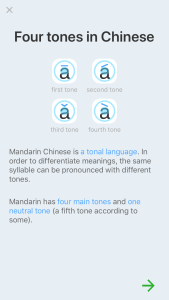 Another problem we often encounter with pinyin is that it is more often than not missing the diacritic marks. Those marks represent the four tones of Mandarin, and are essential in its pronunciation. Unlike in English, changing the pitch of your voice while speaking Chinese can actually change the words you are saying. The pronunciation of mā (“mom”), má (“hemp”), mǎ (“horse”), and mà (“to scold”) only differs in tone. Unfortunately for lazy, toneless English speakers (like me), this makes it really hard for native Mandarin speakers to understand exactly what we’re saying. We try for “mom” and end up with “horse”, something which I hope has been more entertaining than irritating for them!
 Train = Fire + Car
 Alright now! Who’s ready to learn this with me?! Chinese is definitely a language on the rise as far as power and prestige go. Much like what happened to English in the 1700s, increases in immigration, tourism, and business are spreading Chinese to all parts of the globe. In Australia, I was surprised and delighted to find Mandarin on most signage, and, even in Georgia/Florida (quite far away from China), maps and other tourist information can often be found in Mandarin. Some linguists refer to Chinese as the language of the future, and while right now it’s more painfully in my present, I hope to keep it around for my future as well! Wish me luck! 祝我好运!

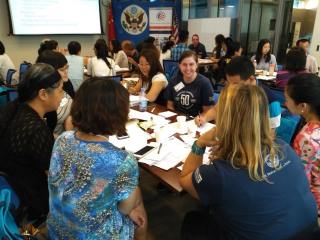
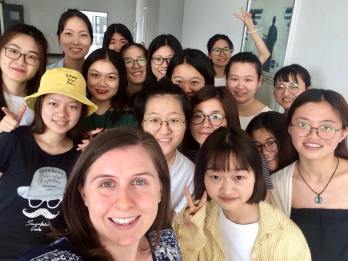
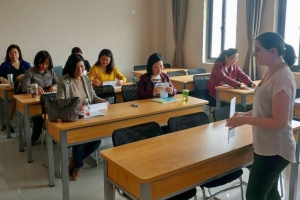






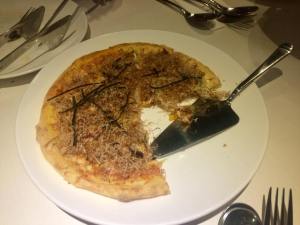
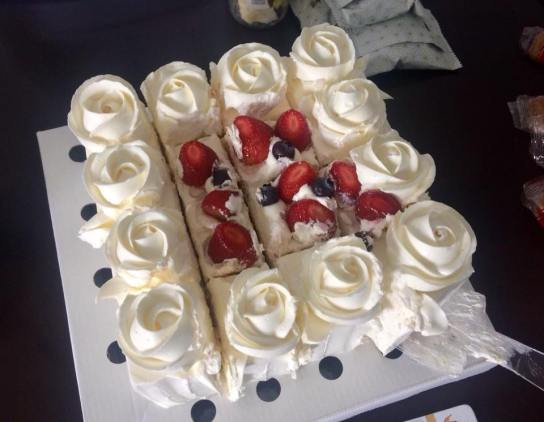
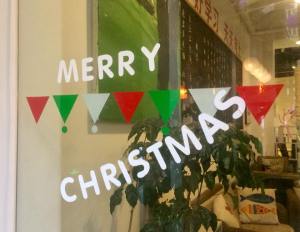
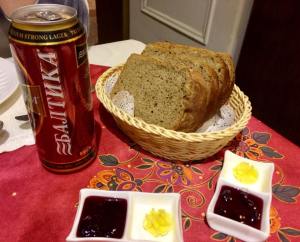

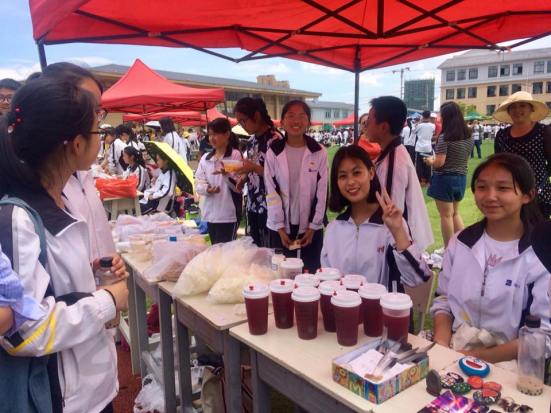















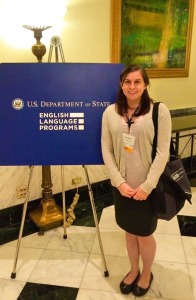 As always, time seems to be whizzing by, and somehow the halfway point of this year’s EL Fellow Program is only a few days away. For my region’s midyear meeting, we’ll be gathering in Thailand and reflecting, sharing, and discussing what we’ve all been doing these last 5 months. I can’t wait to hear about the other Fellows and their experiences, but I also wanted to take some time to write down some of my own. I did something similar when I was halfway through my Fulbright grant, and I was amazed at how it shaped my focus for the next semester. So here it is: my progress report.
 Teaching: The most familiar part of my job is the teaching. I teach English/Linguistics courses to third year English majors at Anhui University in Hefei, China. Their specializations run from linguistics and translation to literature and journalism, and they have a vast array of future goals and career paths in mind. I absolutely love spending time with them in class, hearing their candid thoughts about American culture and the English language as we discuss the challenges of public speaking and critical thinking. As a teacher at AHU, it’s also part of my job to attend and present at Linguistics-related conferences (like ELTAM’s TESOL Conference in Mongolia and the Teacher’s Development Conference in Wuhan). I’ve also been asked to participate as a coach, a judge, or even a “question master” for the various language competitions that the university and the country seem to love! This semester I’ve been involved with the English writing competition, the public speaking competition, and the American culture competition, just to name a few. Additionally, as a somewhat rare (in Hefei at least), native-speaking English teacher, I was invited to lead the university’s English Corner, which meets every other week. This is a chance for dedicated students wanting additional practice to meet up, play some games, and have general conversation in English. It’s also a place where I can ask all my cultural questions, have a little fun with the students, and at the end of the day, call it “work”!


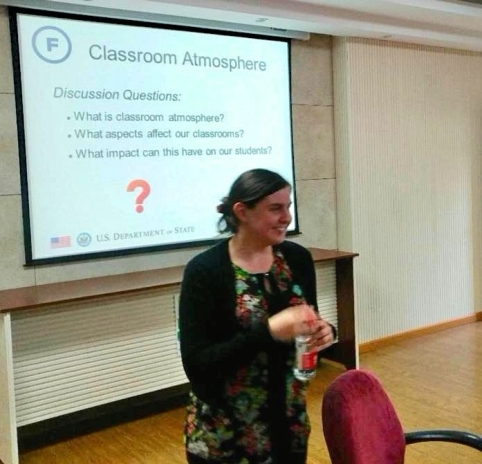 Teacher-Training: Another part of my job is teacher-training. Teachers in China are very interested in Western teaching styles, and are even more interested in teachers trained in Applied Linguistics (like me). For this reason, I usually have at least 1 or 2 visiting observers (usually other English teachers or graduate students) in my classes each week, taking notes on everything from the way I dress to the exact words that come out of my mouth. Luckily I have been able to observe a few of them in return, and we’re working together on blending the education styles of the two countries, as well as discussing concepts like classroom atmosphere and student-teacher roles. I’ve also been really active in facilitating online professional development courses/webinars for my colleagues. They’re extremely motivated teachers, but they don’t always have access to resources like that. Luckily the Fellow program (with the help of American English) provides them in spades. Workshops are another large part of my work here. At my host institution, my supervisor and I have set up monthly seminars where I, a visiting Fellow from another part of China, and occasionally local professors give presentations and workshops to the English department at AHU. I’ve also been able to travel to other universities in China to give these workshops and participate in their professional development activities. It has been a great way to meet new teachers, collaborate with other Fellows, and learn what life is like in other parts of China.


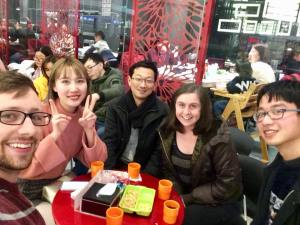 Cultural Exchange: Possibly my favorite part of being in a foreign country is the cultural exchange. Whether it’s through our traveling around the country or through our grocery store encounters, I never get bored of learning the little things about life in a new place. Tucker and I have been very fortunate in the amount of travel we’ve been able to do thus far in and around China. In the last five months we’ve visited Ulaanbaatar, Mongolia and the Chinese cities of Beijing, Nanjing, Shanghai, Wuhan, Huangshan, Xi’an, and Harbin. Some visits were for work, others for pleasure, but all were in the name of cultural exchange. We’ve met so many amazing new friends, seen some absolutely incredible things, and, of course, added to our growing knowledge of this country and its culture. I’m also doing my best to share my experiences (big and small) not only with my students, friends, and colleagues here, but also with anyone else who’s interested (even if it’s just my mom). I’ve become a “social media person”, posting consistently on Facebook, Twitter, Instagram, and WeChat (one of China’s biggest social media apps). I’ve also surprised myself by adding to this blog more than my previously dictated “once a month”. It turns out there is just so much I want to share about living in China! It’s also really fun to share what life was like for us in the US. My colleagues are interested so they can add cultural aspects to their classrooms, my students are interested so they can connect further with the language, and my friends are interested so they can understand why we are so weird about some things (for example, the fact that we enjoy drinking cold water even in winter – weirdos!).


 Expat Life: The last element of my time as an English Language Fellow in China has to be my experience of living the expat life. I decided quite a while ago that the expat life is the life for me, but now in my second year of actually living it, I decided to fully embrace the lifestyle. I’ve joined several expat groups here in Hefei and have met some amazing people that share so much in common with me and Tucker. We’ve had game nights, beer tastings, and other adventures that are made all the more fun by our shared experience of being the “outsiders” here. It’s amazing how quickly groups of expats become like family! Recently I’ve also become a “Warden”, which sounds like a bad thing, but it’s actually sort of a go-between for the US Consulates and any Americans living abroad. Of course, to me another important part of expat life is learning to blend in. Honestly, it’s a bit harder here than it was in Poland, but regardless, Tucker and I are studying Chinese and doing our best to live like locals. We buy our non-perishables from Taobao, we use WeChat or Alipay to pay for everything, and we’ve even been known to yell for the servers (fuwuyuan!) when needed. It’s been an incredibly exciting five months, full of new opportunities, unforgettable experiences, funny situations, personal developments, and so much more. I can’t wait to see what the next half will bring!


 Happy holidays from Hefei! Tucker and I are now into our fifth month of living in China and have just made it through our first holiday season in the Far East. China is the first country we’ve lived in that doesn’t celebrate Christmas as a national holiday, so we were pretty curious to see what it would be like over here. I’ve collected about a month’s worth of holiday observations to share with everyone, so let’s get to it!
 The Lead Up: Holiday decorations were everywhere! Early in December we started noticing Christmas decorations around the city: large, lighted trees, festive window stickers, red bows, etc. Our local supermarkets put up displays and seasonal aisles that sold everything from ornaments and stuffed Rudolphs to full-sized Santa animatronics (only mildly creepy). I had a great time buying a new set of Christmas décor (we now have a set on three separate continents) for our apartment here: stockings, lights, Santa hats, a small tree, etc. We were also able to find some seasonal treats like Andes candies, hot cocoa, and Ferrero Rochers as well. The malls were probably the biggest Christmas perpetrators with decorations on just about every store front, staircase, and atrium. People were often lined up to get their pictures with Santa or to enter the “Secret Wonderland”, which to us looked like a small, dark room with tons of white Christmas lights on the ceiling. Of course, many American chains like Starbucks and Dairy Queen also had their usual holiday specials advertised in the usual places, and Christmas music (particularly Jingle Bells) could be heard in most stores and restaurants throughout the month.


