That Was Unexpected! As Was That…

31144029_10216476090563099_1771299139375349937_n
Family selfie!

Last month my parents visited us in China, and I think it’s safe to say everyone learned quite a bit! Tucker and I learned a little more about what it’s like to be responsible for people other than ourselves (consistently asking if everyone had what they needed, were they hungry, did they understand, etc. It was exhausting!), and my parents definitely learned a lot more about the Middle Kingdom, this time, firsthand.

When they arrived after their very long flight, we met my parents at the Airport Express station in Beijing. We then spent the following two weeks fitting in as much Chinese culture, food, and fun as we possibly could! We spent a few days each in Beijing, Shanghai, Huangshan, and Hefei: four very different cities in China. Of course, we did lot of touristy things (like walking the Great Wall, shopping on Nanjing road, and hiking Yellow Mountain), but we also went grocery shopping, met Chinese friends for dinner, and spent some time just hanging out in our campus apartment. Overall I think it was a well-rounded trip, and even though we were often on the go, we did still find some time to talk about the things that surprised my parents most about China.

31265336_10216486806390988_8557087024694336051_n
I can’t stress enough how much there is to see in China.

Delightful Surprises: There seem to be three areas in which China excels in my parents’ eyes: restaurants, transportation, and safety. Very early on they were impressed with China’s restaurant game. A la carte menus, ordering for the table (rather than individually), food coming out as it’s ready, and the lack of tipping just to name a few of the positives. They also, as does everyone, loved paying for everything through a mobile phone app (like WeChat or Alipay) – it’s so quick and easy: no receipt, no signing, no waiting! My mom also really enjoyed the plastic tops and to-go bags for drinks on the run, another innovation that we don’t see much of in the US.

31124689_10216468532094142_6756384212000522965_n
Family-style meals

As far as transportation goes, they were most impressed with how fast, cheap, and punctual everything was. China doesn’t usually have the reputation of timeliness like, say, Japan, but every train we took left on time or a minute early. They were also amazed that with as many people as China has, the traffic wasn’t really bad and any/all lines moved pretty efficiently. Even I was doubting a few times during the peak tourist hours at the most popular destinations, but even some of the longest lines we had ever seen still moved along pretty rapidly. No dilly-dallying here!

22007944_10214679398486920_5059747423061294812_n
“Flat toilets”

In China my parents also mentioned safety fairly often: how safe they felt with the cameras, hotel check-ins, and security presence and how welcomed they felt as foreigners. They also noticed fewer homeless people and a great emphasis placed on family time and family connections. Perhaps not directly related to safety, but my mom was also extremely pleased that the hole in the ground that she was imagining China toilets to be was entirely exaggerated, and that they are actually pretty clean and easy to use.

Not So Delightful Surprises: Of course, leaving the familiar can always lead to a few uncomfortable surprises as well. One of the most common difficulties foreigners have in China is adjusting to some of the culinary differences, and my parents were no exception. They mentioned the lack of ice in drinks and the lack of good coffee a few times. My dad had also not expected the lack of meat in many Chinese dishes (probably because American-Chinese food is all about the meat). And of course, even after only two weeks, they also started craving Western favorites like a bacon cheeseburger or a plate of fettuccine Alfredo (imagine the cravings after nine months!).

31369382_10216493849407059_7343932562646878862_n
Tea > coffee anyways…

Some other unpleasant surprises seemed related to the expectations of personal boundaries. My parents noticed pretty quickly that a person’s “personal bubble” is much smaller in China, and that bumping shoulders is a way of life here. They also weren’t so pleased with finding themselves head-to-head with a bicycle, scooter, or even the occasional car on the sidewalk (something I was already used to thanks to Poland). And finally, coming across several street-spitters and the rare, but still present, late night street-urinators were also surprises that didn’t exactly fall into the positive category.

31180116_10216476094763204_5471004553647765357_n
Nothing like pushing through the hordes

A third area of perpetual surprises seemed to be in the lack or inferiority of paper products in China. Due to China’s vast size and population, many public restrooms and restaurants do not provide general-use paper products, instead, customers carry around their own packs of tissues to use however and whenever they’d like. Even when some restaurants do provide “napkins”, my parents correctly pointed out that they would be better off using their pants than the tiny, thinner-than-tissue-paper pieces they could get there. And while, as my parents also noticed, this does actually have a positive impact on the potential overuse of resources, it can be pretty annoying when you find yourself without a multi-purpose paper pack in hand.

31224164_10216493904128427_7402362084022758603_n
The adventurers!

It’s always interesting to see what expectations are met or broken upon first arrival to a new place! Although my parents did have a lot of advanced information from my photos, blog posts, and stories, it was still so much fun to see them experience life in China for themselves: the good, the bad, and the ugly. I’m so proud of my parents for seamlessly adapting to the ambiguity, and at times, insanity, that comes with immersing yourself into a very different culture, and I’m so thankful we were able to share this experience together! I truly can’t wait to do this again with another culture in a few years, and for the impending reverse culture shock I’m sure to experience when we’re back in the States at the end of the summer!

A Tale of Two Cities

Lodz, Poland and Hefei, China are two cities that 1) not many people have heard of and 2) don’t really seem like they’d share many similarities, but I feel it’s my job as a former resident of one, and a current resident of the other to share some interesting information about these two beautiful places, perhaps increasing their notoriety and proving that two very different cities can actually have quite a lot in common.

Maps
Putting Lodz and Hefei on the map so to say

Similarities: For me (and Tucker, as I’ve enlisted his help with the following comparisons), the most prominent similarities lie in the locations, reputations, and inhabitants of the two cities.

22195264_10214729970591191_5289724843025802938_n
Train travel in China

Location: Both Lodz and Hefei are somewhat centrally located within their respective countries. They are cities that are not known for their tourist attractions, but are instead used as transportation hubs. All the train routes and major highways, for example, seem to connect through these large, regional capitals. We have absolutely loved this feature in both locations because it has made our travels around Poland and China significantly easier (and cheaper). We have also found that both cities are surrounded by farmland. Unlike the US, which seems to be the land of never-ending suburbs, both Lodz and Hefei have a very clear line between city and countryside. This clear division never fails to amaze me as we ride a train out of the city, and I look down for a moment only to look up and see fields and tractors rather than high-rises. While, we knew both cities were geographically in the middle of their nations, the ease and plethora of transportation options and the stark city to farm transitions were not something we anticipated finding in one, let alone both cities.

12065782_10207974487068325_7412578985637222695_n
Cityscape in Lodz

Reputation: Another similarity we’ve run into is what the two cities are most known for. Lodz was described to us as the Detroit of Europe (or the Manchester of the Continent), a place where industry was king. In Hefei, it is and has always been about business as well; whether the tea or other Anhui specialties from the past or the engineered or technological goods of today, Hefei is also place where industry has thrived. Both cities are also well off-the-beaten track as far as travelers are concerned. Many people travel to Poland and to China, but far fewer have made it to Lodz or Hefei. For that reason, I think the two cities share a sense of undisturbed cultural “essence” that places like Kracow and Shanghai can’t quite advertise. We often joke that we live in “real” China as opposed to places like Beijing or Hong Kong, which have many international residents and conveniences that might not feel that different from any other large city. Lodz also felt like a part of “real” Poland, and no matter which country we’re in, Tucker and I have definitely preferred being one with the locals.

Inhabitants: A third similarity that has appeared in so many ways is in regards to the people. Both Lodz and Hefei, possibly as a result of their lack of tourism, are fairly homogeneous cities. I remember in Lodz feeling like I was missing out on the diversity that, to me, made a city like Atlanta something special. Hefei is similar in that the vast majority of people fit a very similar mold. Even the names fit very specific standardizations in both locations. In one of my classes in Poland I had six students named Marta, four Michals, etc. In China it’s the same but with the last names, I have seven students in one class with the surname Zhang, five with Liu, etc. We’ve also found hospitality to be very highly valued by the inhabitants of both Lodz and Hefei. People in both cities have been extremely welcoming towards us whether we have a connection (via friends or work) or not. From snack offerings and dinner invitations to personal tour guides and assistance with even the most mundane tasks, strangers, acquaintances, and friends alike went out of their way in both cities to be friendly and hospitable to us, the newbies on the block.

The last similarity that I want to mention, which may even be the reason I’m writing this post, is that people from Lodz (Lodzites, as we call them) and people from Hefei (Hefeians) both regard their cities as “nothing special”. When people asked me what my favorite city in Poland was, truly my answer was Lodz, and they didn’t believe me! Now when I talk about all the things I like about Hefei, I’m met with suggestions for other cities to visit in China. Maybe this can be boiled down to the “grass is always greener” adage, or maybe some form of modesty, but really I think both Lodz and Hefei are great places to visit or to live.

Honorable mentions for similarities: Some other things that stick out as oddly similar between the two cities include:

The prevalence of shopping malls, the of ubiquity of uneven pavements (it’s unclear as of yet whether I’ve tripped more often in Poland or in China), the common appearance of cars on these uneven pavements (i.e. sidewalks, store fronts, etc.), and the the popularity of duck (as opposed to other poultry).

Differences: I don’t think my information about the cities would be entirely complete if I didn’t at least briefly outline some of the differences we’ve encountered as well. When thinking about the ways the two cities are not alike, interestingly, I still come to the features of location, reputation, and inhabitants.

29572656_10216254224576588_8078274557762368306_n
Skyline in Hefei

Location: The size of the two cities is quite different. Lodz has a population of about 100,000, while Hefei has between 6-8 million. With the population difference, of course, comes a difference of area. Lodz was fairly walkable; usually we chose to take buses or trams, but if it got too late, we could walk home if we needed to. We were also able to walk to the grocery store, a nearby mall, several parks, etc. In Hefei there is no way to get around solely by walking. It takes us over an hour to get to the other side of the city in the best of circumstances, several hours by bus. In Hefei we end up taking taxis a lot more than we ever have before (cheap, reliable, and fast – can’t be it!). Another locational difference is the fact that Poland is surrounded quite close on all sides by different cultures. Europe, in general, has been mixing the cuisines, festivals, etc. of its various nations for quite a while. China, while also surrounded by other countries/cultures, is much larger and only newly “open” for mixing. The difference these facts have made on the cities is quite evident. In Lodz we could go to an Italian, French, Turkish, German, Chinese, or any other restaurant we might want on any given night, while in Hefei, it’s pretty much Chinese all around. There is variety to be had (Sichuanese, Canton, Beijing-style, etc.), but ultimately to me, it’s still all Chinese.

11209456_10207932592860996_3955888081745318072_n
Skyline in Lodz


12038422_10207932594141028_5327132447317339741_n
Church in Lodz

Reputation: Another difference would have to be the government systems, and perhaps even more than that are the views towards the government systems. In Lodz, I talked about politics more than I ever had previously in my life. We talked about Poland’s history, laws, elections, etc. all the time. I learned that Poland had the world’s second democracy, I heard the word “solidarity” more often than I would have thought possible, and of course, I observed all the negativity surrounding the ideals of communism (which is really no wonder given Poland and Russia’s history). However, now that I’m in Hefei, politics are pretty well avoided. Solidarity has perhaps been replaced with “CPC”, and communism is viewed completely differently, which makes sense, as it is completely different than the former Russian system we’ve all read about. Another large difference in regards to reputation is the presence of religion in Lodz and the almost complete absence of it in Hefei. I took hundreds of photos of churches during my time in Poland, and I think I’ve seen maybe four over the past seven months in China. It’s also interesting to note that in Poland many people loved arguing over the influence the church had/has on the government, but in China that’s just not even possible.

31880916_10216555050617051_4821020542591041536_n
Temple in Hefei
12994342_10209425532783561_1010005547983809805_n
Polish offerings

Inhabitants: Finally, there are definitely some differences among the people of Lodz and Hefei. While I mentioned both populations were incredible hospitable, their ways of showing it are completely different. In Poland people had a motherly way of treating guest: Did we want something to drink? Something to eat? Are we cold? Etc. We were asked over to people’s houses for the holidays, and we had no trouble connecting to people on a casual, friend level. In China, we’re treated more like honored guests. We are given the best seats in the house, gifts, toasts, red-carpet treatment (sometimes literally). While hospitable, occasionally we feel a little isolated by this guest-treatment, which has taken a bit of time to overcome and finally allow us to reach the friendzone. Another obvious difference would be lifestyles. In Lodz it seemed like a quiet life was desired. Most people in the city kept to themselves and enjoyed quiet activities like reading or silently playing mobile games while making it through the day (the great exception to this being when a Polish sports team was on TV). In Hefei, however, I’m not sure there’s ever a truly quiet moment. Cars and buses blast their horns around the clock, people listen to surprisingly loud audio messages wherever they are, and with the singing street sweepers and an abundance salespeople armed with loudspeakers, it’s safe to say people here aren’t concerned with the quiet life.

Honorable mentions for differences: Some other notable differences include:

The amount and importance placed on alcohol as a form of socializing, the ability to regulate indoor temperatures (in Lodz we couldn’t cool down our apartment, and in Hefei we can’t heat it), the emphasis placed on the quality of food, and last but not least, the language (there’s way too much to say about the differences in this aspect, so I’ll save it for a later post).

I’m not sure if anyone really wanted quite that much information about Lodz and Hefei, but when I start talking (or writing) about these two places I always find that I have so much to say! Ultimately though no matter the similarities or differences we’ve found, the most remarkable things we’ve taken away form our time in both Lodz and Hefei are the things we’ve learned, the memories we’ve made, and the people we’ve met. And personally, I can’t wait to find out which city we’ll be adding to the comparison list next!

Logos
I <3 Lodz & Hefei

Chinese Food: Where’s the Sesame Chicken?!

Tucker and I used to order Chinese food fairly often when we lived in Atlanta. It’s quick, it’s cheap, and it’s utterly delicious, but as I’m what I like to call a “safe eater” (read: picky), I only ever ordered Sesame Chicken, Beef with Broccoli, or some other entirely Americanized dish. However, now I find myself living in the Chinese food homeland (allegedly), and since I have yet to see anything remotely resembling those two stand-bys, I’m going to share some of my new favorite Chinese dishes. REAL Chinese food!

But First, About Meals: Mealtimes in China are quite similar to what I’m used to from the US – an early, light breakfast before work, lunch around noon, and a larger, warm dinner in the early evening. A little less familiar is the utter lack of liquids. I’ve previously mentioned the Chinese affinity for drinking hot water throughout the day, but what I haven’t yet described is the fact that it’s rare for locals to have a drink (of anything) while eating. Occasionally they’ll have a small bowl of soup or broth, which they use as a drink substitute, but most people eat OR drink rather than what I previously thought was universal, eat AND drink.

21743187_10214553841508074_4640986990806566948_n
“Broth drink” with chao mian (fried noodles)

Another thing that stands out is the absence of sweet options. I’m used to having the option of a sweet breakfast and almost always being offered dessert after dinner, but these phenomena are rarer in China. Instead of cereal, pop-tarts, waffles, etc. we see people eating noodles and pork buns on their way to work/class. As a fan of leftovers for breakfast and a former noodletarian, I love that there’s no judgment for eating noodles multiple times a day! However, I do miss the occasional dessert. Sometimes in a vain effort to satisfy my sweet tooth, I’ll pick up a dessert-like-thing from Wal-mart or the campus store, and nine times out of ten, I’m disappointed by a bite of red bean instead of chocolate. Our Chinese friends swear red bean is a dessert (and a sweet one at that), but coming from the US, where processed sugar is pretty much its own category in the food pyramid, I haven’t found much that’s up to my “sweet” standard.

21430167_10214475840118088_2088951251781114025_n
Family style eating in China

What we usually think of as “Family Style” serving/eating is another prominent characteristic of Chinese meals. It’s fairly rare to go out with a group (even a small group) and each order one individual dish. Instead everyone agrees on 8-10 dishes and shares everything, often at a table with a large lazy-susan in the middle for easy reaching. Tucker loves this way of dining out because he gets to try many different dishes all at one meal, and, of course, I don’t like it for the same reason. Have I mentioned it’s really difficult to be a picky eater in a foreign country?


Regional Cuisine: Very early on we were told about the different regional cuisines of China, and have since discovered that many restaurants will choose a specialty and run with it. For that reason, we can find Beijing, Sichuan, or Hong Kong style restaurants in pretty much every Chinese city; just like we can go to any city in the US and find Italian, Mexican, and Chinese places. Also similar to the US, many Chinese cities have special foods that are almost synonymous with that place (think deep-dish pizza and Chicago or cheesesteaks and Philadelphia). Every time we tell friends about our travels plans, they immediately tell us which foods we have to try when we get there. We’ve had the Hot Dry Noodles (Re Gan Mian) of Wuhan, the Sweet and Sour Pork (Gou Bao Rou) of Harbin, the Egg Puffs of Hong Kong, and many others.

My Favorite Dishes: Okay, time to make your mouth water! Here are the Chinese foods I’ve come to love over the last 6 months:

Dumplings (Jiao): Of course! Boiled (shui jiao) or fried (guo tie), filled with meat or vegetables, these are a staple in my life. You can get them in soup or not, with sauce or not, and we’ve even been known to buy them by the dozens in the frozen food section of the grocery store. Everyone loves dumplings, and China has the best I’ve ever had.

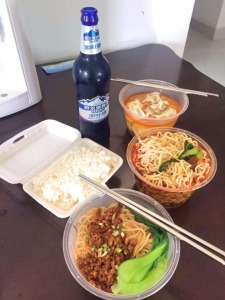
Noodles (Mian tiao): Another favorite that has more variations than I could possibly write out are the noodles of China. There are noodle soups (mian tang), mixed sauce noodles (zhajiang mian), cold noodles (liang mian), handmade noodles, and the list goes on. Noodles disheds can run the flavor gamut from spicy Sichuan style to sour, vinegar-forward Anhui varieties. I’m pretty sure my Chinese friends, students, and colleagues think the only thing I eat is noodles…

Ji Pai: Translated as “chicken steak”, it’s basically sliced, fried chicken breast served over steamed rice. The campus restaurants serve it with a white sauce (sha la – like salad, as in salad dressing), and it’s delicious! Crispy and juicy with a delicious cream-based sauced (another rarity in China), it ensures I don’t only eat noodles.

Dry Pot Veggies (Gan guo cai): A little difficult to describe, “dry pot” refers to the way these dishes are served: in a wok placed over a small burner on the table. They bubble and continue to soak up the sauces and spices in the wok as everyone works to mix and eat them up. Our favorites include dry pot cabbage with bacon, cauliflower with peppers, and spicy potatoes and onions.

23754724_10215123435787575_8960182072138635696_n
Dry pot cauliflower with Hui style dumplings and noodles

Sticky Potatoes (Ba Si Hongshu): It is no secret that I love potatoes. In Poland I ate boiled potatoes with dill just about every other day, but in China, this is my go-to potato dish. Fried sweet potatoes with a sweet, sticky glaze on top – what’s not to love?

23434747_10215055070598488_974118110432381643_n
Close up of a tiny tomato rabbit (and some sticky potatoes)

Hot Pot (Huo guo): I call this Chinese Fondue, but it’s not quite the same. Hot pot (literally translated as “fire pot”) is a sort of soup or broth that’s used to cook meats and vegetables at your table. There are many choices to be made when eating hot pot, like which style of broth (spicy, mushroom, tomato, etc.) and which foods to cook/eat, meats (the most popular being lamb, pork, beef, and shrimp), vegetables (like cabbage, cucumbers, and potatoes), and many other choices (including bamboo shoots, bread, mushrooms, noodles, etc.).

Fast Food: I’m not going to lie. There have been times I’ve craved “familiar” food, broke down, and went to a fast food chain for some nostalgia (and let’s face it, ease). In China we have plenty of McDonalds, KFCs, Subways, Burger Kings, and Pizza Huts. We’ve also seen Dominos, Dunkin’ Donuts, Haagen Dazs, and an Outback. If ever we find ourselves at a place like this, I safely, happily order something that I know and love, and Tucker tries the more adventurous route: like a shrimp burger at McDonald’s and a coffee and mochi blizzard at Dairy Queen. He’s a food gambler, and it has yet to truly pay off – fast food classics are popular for a reason, regardless of country.

27973116_10215926835712071_909623160974637162_n
Classics for me, shrimp burger for Tucker

To be honest this is just the tip of the Chinese food iceberg. In such a vast, diverse, and old country, there’s bound to be a plethora of culinary options. Maybe in the future I’ll write about Chinese snack foods, holiday foods, crazy menu translations, and/or the dishes that scare the hunger right out of me. Until then, I’m just going to eat some more noodles.

Progress Report

20429997_10214152247508475_7037007486182596654_n (1)As always, time seems to be whizzing by, and somehow the halfway point of this year’s EL Fellow Program is only a few days away. For my region’s midyear meeting, we’ll be gathering in Thailand and reflecting, sharing, and discussing what we’ve all been doing these last 5 months. I can’t wait to hear about the other Fellows and their experiences, but I also wanted to take some time to write down some of my own. I did something similar when I was halfway through my Fulbright grant, and I was amazed at how it shaped my focus for the next semester. So here it is: my progress report.

The EL Fellow Program places experienced English teachers from the US into various contexts all over the world, so we can interact with students, teachers, and other professionals by learning, sharing, and working together in our new environments. The main two jobs I have at my host institution are related to teaching and teacher-training; however, as an individual from one culture living fully immersed in a different culture, I’m quite engaged in US-China cultural exchange and general expat life as well. Looking at each of these roles, here’s what I’ve been up to since last September:

1 (1)Teaching: The most familiar part of my job is the teaching. I teach English/Linguistics courses to third year English majors at Anhui University in Hefei, China. Their specializations run from linguistics and translation to literature and journalism, and they have a vast array of future goals and career paths in mind. I absolutely love spending time with them in class, hearing their candid thoughts about American culture and the English language as we discuss the challenges of public speaking and critical thinking. As a teacher at AHU, it’s also part of my job to attend and present at Linguistics-related conferences (like ELTAM’s TESOL Conference in Mongolia and the Teacher’s Development Conference in Wuhan). I’ve also been asked to participate as a coach, a judge, or even a “question master” for the various language competitions that the university and the country seem to love! This semester I’ve been involved with the English writing competition, the public speaking competition, and the American culture competition, just to name a few. Additionally, as a somewhat rare (in Hefei at least), native-speaking English teacher, I was invited to lead the university’s English Corner, which meets every other week. This is a chance for dedicated students wanting additional practice to meet up, play some games, and have general conversation in English. It’s also a place where I can ask all my cultural questions, have a little fun with the students, and at the end of the day, call it “work”!

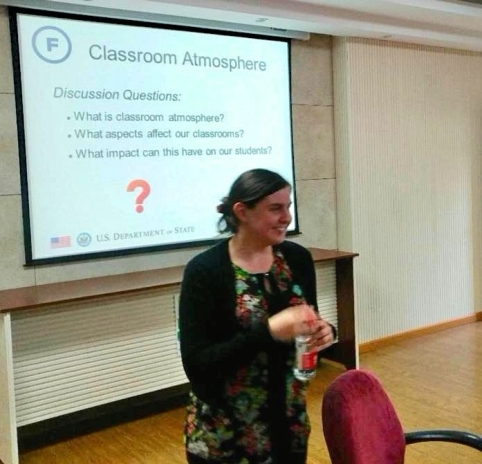
5 (1)Teacher-Training: Another part of my job is teacher-training. Teachers in China are very interested in Western teaching styles, and are even more interested in teachers trained in Applied Linguistics (like me). For this reason, I usually have at least 1 or 2 visiting observers (usually other English teachers or graduate students) in my classes each week, taking notes on everything from the way I dress to the exact words that come out of my mouth. Luckily I have been able to observe a few of them in return, and we’re working together on blending the education styles of the two countries, as well as discussing concepts like classroom atmosphere and student-teacher roles. I’ve also been really active in facilitating online professional development courses/webinars for my colleagues. They’re extremely motivated teachers, but they don’t always have access to resources like that. Luckily the Fellow program (with the help of American English) provides them in spades. Workshops are another large part of my work here. At my host institution, my supervisor and I have set up monthly seminars where I, a visiting Fellow from another part of China, and occasionally local professors give presentations and workshops to the English department at AHU. I’ve also been able to travel to other universities in China to give these workshops and participate in their professional development activities. It has been a great way to meet new teachers, collaborate with other Fellows, and learn what life is like in other parts of China.

9Cultural Exchange: Possibly my favorite part of being in a foreign country is the cultural exchange. Whether it’s through our traveling around the country or through our grocery store encounters, I never get bored of learning the little things about life in a new place. Tucker and I have been very fortunate in the amount of travel we’ve been able to do thus far in and around China. In the last five months we’ve visited Ulaanbaatar, Mongolia and the Chinese cities of Beijing, Nanjing, Shanghai, Wuhan, Huangshan, Xi’an, and Harbin. Some visits were for work, others for pleasure, but all were in the name of cultural exchange. We’ve met so many amazing new friends, seen some absolutely incredible things, and, of course, added to our growing knowledge of this country and its culture. I’m also doing my best to share my experiences (big and small) not only with my students, friends, and colleagues here, but also with anyone else who’s interested (even if it’s just my mom). I’ve become a “social media person”, posting consistently on Facebook, Twitter, Instagram, and WeChat (one of China’s biggest social media apps). I’ve also surprised myself by adding to this blog more than my previously dictated “once a month”. It turns out there is just so much I want to share about living in China! It’s also really fun to share what life was like for us in the US. My colleagues are interested so they can add cultural aspects to their classrooms, my students are interested so they can connect further with the language, and my friends are interested so they can understand why we are so weird about some things (for example, the fact that we enjoy drinking cold water even in winter – weirdos!).

12Expat Life: The last element of my time as an English Language Fellow in China has to be my experience of living the expat life. I decided quite a while ago that the expat life is the life for me, but now in my second year of actually living it, I decided to fully embrace the lifestyle. I’ve joined several expat groups here in Hefei and have met some amazing people that share so much in common with me and Tucker. We’ve had game nights, beer tastings, and other adventures that are made all the more fun by our shared experience of being the “outsiders” here. It’s amazing how quickly groups of expats become like family! Recently I’ve also become a “Warden”, which sounds like a bad thing, but it’s actually sort of a go-between for the US Consulates and any Americans living abroad. Of course, to me another important part of expat life is learning to blend in. Honestly, it’s a bit harder here than it was in Poland, but regardless, Tucker and I are studying Chinese and doing our best to live like locals. We buy our non-perishables from Taobao, we use WeChat or Alipay to pay for everything, and we’ve even been known to yell for the servers (fuwuyuan!) when needed. It’s been an incredibly exciting five months, full of new opportunities, unforgettable experiences, funny situations, personal developments, and so much more. I can’t wait to see what the next half will bring!

Living in China: Daily Differences

23130648_10214977335335155_6425516221530541009_n (1)
Temples in our backyard!

We’re almost three months into our move to China, and something that we’re asked pretty regularly is: what are the differences we notice in our daily lives. Most people are aware of the obvious differences like the language and the food, and, although most daily activities are pretty universal (shower, eat, work, play on your phone, etc.), there are definitely some things that we didn’t really have a need to think about before moving to China. In reality, these are rather small differences, but their regularity and new-found importance have kept them in our minds daily as we shift into a new way of living – the China way!


21751831_10214553838387996_1478804182428819340_n (1)
“Noodles 22” – my favorite!

First is our struggle for food. Of course, as I mentioned, the food itself is obviously quite different. For example, most things are cooked in oil here rather than in butter, and almost everything (from drinking water to what some refer to as a “salad”) is served piping hot. However, something we didn’t think about is how difficult it would be to obtain our food, let alone the foods we actually prefer. Whether at a restaurant or a grocery store we have to put a lot of effort into translating food items. Even then, we’re often not sure what we’ve actually purchased. In the last week alone we’ve gotten translations like “sealed duck palm”, “saliva chicken”, and “fried enema” – I’m sorry, what?!

21686126_10214628783901587_1078398650307237772_n (1)
“Fruit Parkway”

At the grocery store, things are not only hard for us to read, but they’re often packaged differently or organized in a way we would have never thought of; for example, milk is not refrigerated, but pasta is! On top of these difficulties, there is also a sense of lingering mistrust. We’ve all heard stories about China and the shortcuts they may have taken, so when we see something unfamiliar or “weird”, we’re conditioned to think it’s not healthy or good. The depth of these feelings really surprised me because, although I saw similar things in Poland, I never questioned the hygiene or motives there. This is something we’re really working on by constantly asking “why” and delving a little deeper into these differences. Our Chinese friends have been incredibly illuminating, and honestly, we’ve learned to look at our own way of doing things a little differently as well.

22814129_10214916132805130_4342214456280253414_n (1)
If this doesn’t scream “weird”, I don’t know what does…
IMG_8615 (1)
Do I wear it well?

Another daily difference for us is the general environment that we’re living in. Typically when I wake up, the first thing I do is check the weather. However, in China, I must also check the AQI (air quality index). We live in a city of 8 million people; a city that still uses coal to heat some of its building and has farms just outside the city limits that burn their fields twice a year before replanting. These conditions mean that the air quality in Hefei can have an effect on my day. If the AQI is above 200, I need to wear a mask to ensure that I don’t get a sore throat the next day. Checking the AQI and occasionally wearing masks have become part of our routine. In our (almost) 90 days here, we’ve only had a handful of “bad days”, which we recently found out are about the equivalent of smoking a few cigarettes (and we all know that is not great for long term health).

21557452_10214502718510031_1066655538901985017_n
An exciting acquisition!

Another environmental issue I was not at all looking forward to was the inability to drink the tap water. I remember last time we were in China, I had a really hard time making sure I had enough water bottles. Something about steaming hot water served in restaurants (even in summer) really just didn’t agree with me. Turns out, although this is a difference, it really isn’t a difficult one to handle. Now that we’re residents of China, it’s pretty easy to get water. We have a water cooler and a weekly delivery that ensures we have plenty of drinking water (hot OR cold)! Another environmental difference, for Tucker, would have to be the height of everything. Doorways, sinks, counters, they’re all much lower than we’re used to, and he (just about 6 feet tall) struggles with hitting his head and constantly bending over at an uncomfortable angle. I (at 5’3”) don’t really have this problem!

21462860_10214530461363585_3988519170618761027_n (1)
Tucker’s Taobao fail

Finally, the way we use technology has also changed greatly. It seems that in some ways we’re using technology more efficiently, and in others it’s substantially slowed down or non-existent. For one thing, in China you are not allowed to have two people sharing one bank account. Therefore, Tucker and I “share” my card by handing it over whenever one of us needs it, which just feels so strange! Online banking is also not very popular here, and it’s only possible with a monthly fee. Needless to say, Tucker and I have become much more familiar with the “balance inquiry” function at the ATM. While those banking aspects feel less than modern to us, we’re also being ushered into the future by instead paying for everything with our phones and buying most of what we need from an online service that delivers to our door. The saying “there is an app for that” feels so true in China, as we now utilize our phones for everything! Even street vendors use QR codes for payment!

Capture 2
Love seeing this!

However, possible is not the same as familiar. As westerners new to China, our most valued service is a VPN (virtual private network). As many people know, China is very particular about what shows up on their search engines (or even which search engines are available), and for this reason, we need to use a VPN to access YouTube, Facebook, Instagram, and several other favorites. Of course, for nationals and people who have been here long enough, those services are no longer as important as YouKu, WeChat, and QQ (Chinese versions of the same services), but for now, we’re bogged down remembering to connect to the VPN for some things and at times, not having enough bandwidth to do so.

There are plenty of other differences in our daily lives, and some, as we’re beginning to see, are less China-specific and more like everywhere-but-in-the-US kind of things. We find ourselves walking so much more here, watching less TV, meeting with very different groups of people, and taking advantages of opportunities that we would’ve never had at home. There are so many reasons I enjoy my life abroad, but I think none are as great as these small differences that teach us so much!