Initial Québec Observations

We’re almost halfway through April, and we’ve now officially been living in Québec for six weeks, which is crazy since it feels like the move was just last weekend, but that’s how the first few months always go. We get caught up in a daze of setting things up, collecting documents, making appointments, etc. But luckily, this isn’t our first rodeo! Not only are we completely on top of all our paperwork and logistical tasks, but we’ve also made good progress on our observations list. So how different is Québec from Ottawa? Well, here are the first few things that have caught our attention:

The French

Of course, the absolute first thing on the list has to be the use of French. While Ottawa is fairly bilingual, and we definitely got quite a bit of French exposure there, English was still absolutely the reigning language, sometimes even in Gatineau (which is technically in the province of Quebec). In Québec City, however, we’re not only expected to use French 100% of the time, we’re actually legally required to after six months of living here, which is honestly really great motivation!  

The Salutations

Living in multi-story apartment buildings means we tend to have a lot of neighbors, so we’re usually pretty quick to notice how (and how often) acquaintances interact, like in an elevator, the lobby, the parking garage, etc. In Ottawa, most people kept to themselves or smiled politely in passing, but here in Québec, it’s a steady stream of “bonne journées” and “bonne soirées” no matter how brief your interaction is. It reminds me so much of all the “buenos días” and “buenas tardes” we got in Mexico, and it immediately feels so welcoming!

We’re in a Port City
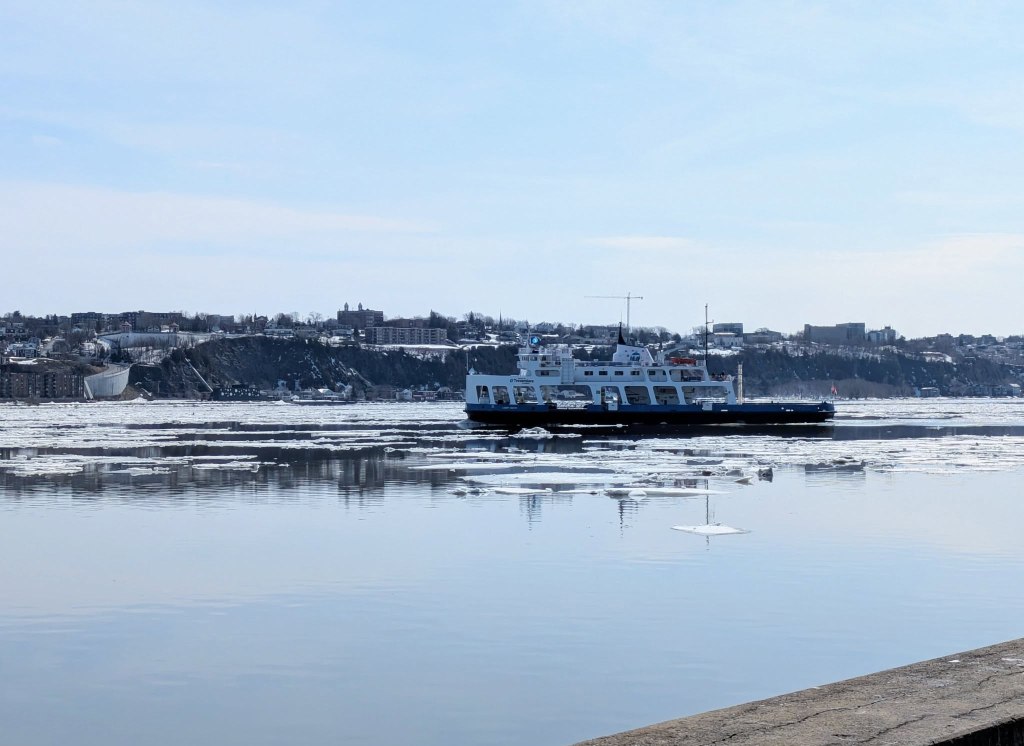
Ottawa is definitely a water city of sorts with two major rivers and a canal running through it, but Québec is even more water-forward. The Québec City icon is fittingly a ship, and with ferries being a common means of transport, international cruise ships docking nearby, and whale watching tours every weekend, we’re not just between rivers anymore, we’re practically seafaring. At least the seagulls make more sense here.

Bizarre Hours

I have no idea if this is a French thing or a Quebec thing or a Québec City thing, but we have noticed that stores, restaurants, and pretty much every kind of business here has bizarre hours. Monday 8:30-4, Tuesday 9-6, Wednesday, Thursday, Friday 10-2…I mean, what? Do they just like to keep us guessing or is there some hidden meaning behind these choices? We definitely need more time to investigate.

Definitely not easy to remember…

Laidback Vibes

This might have more to do with Ottawa being the nation’s capital and less to do with Québec, but we’ve definitely noticed things are a little less official here. Our car registration (ou immatriculation) is printed on regular printer paper rather than fancy cardstock, our lease paperwork was submitted while we were still missing a few things, and we’ve gotten several messages along the lines of “X will be sent to you at a later date”. Definitely feels like a slower pace here in general.

Flashing Green Lights

Another thing we immediately noticed (and subsequently had to google) are the flashing green lights or “advanced greens”. Very often in Québec, you’ll come to a stop light and the green light will be flashing, which we learned means it’s basically both a green light and a green arrow. Apparently, this is common in a lot of Canadian provinces (including Ontario), but we had never seen it or at least not regularly enough to really register a difference.

Pedestrian-friendly

Ottawa is pretty pedestrian-friendly as well, but in Québec (at least downtown) the crosswalks are set up to allow for regular double crossing. Instead of waiting for the lights to change and basically taking your turn to cross when the flow of traffic changes direction, cars will be stopped in all directions allowing people to cross diagonally if they want/need. This and the no-touch crossing sensors make this particular pedestrian so happy!

Vestiges from France

I didn’t know how else to label this one, but smoking is much more common here. And by smoking, I mean cigarettes. We went from smelling a lot of marijuana in Ottawa to smelling a lot of cigarettes in Québec, and I can’t help but feel the cultural influences in that.   

Drinking Culture

In a similar vein, Ontario seemed pretty strict when it came to alcohol sales/consumption. It was rare to see alcohol (even beer and wine) sold in stores, but in Quebec, that’s the norm. BYOB is also more frequent here, and it’s custom to bring wine to a park for a picnic.

Food Culture

We’ve also noticed a lot differences when it comes to food. The groceries here are overall cheaper, yet the selection of “fancy” food is definitely wider. There are like three types of caviar sold at the grocery store right next to our building, and if you wanted to try each type of cheese sold there, you’d need a few years. Restaurants here also seem to be a bit fancier – for example, there are fewer fast-casual options than in Ottawa, but way more multi-course menus.  
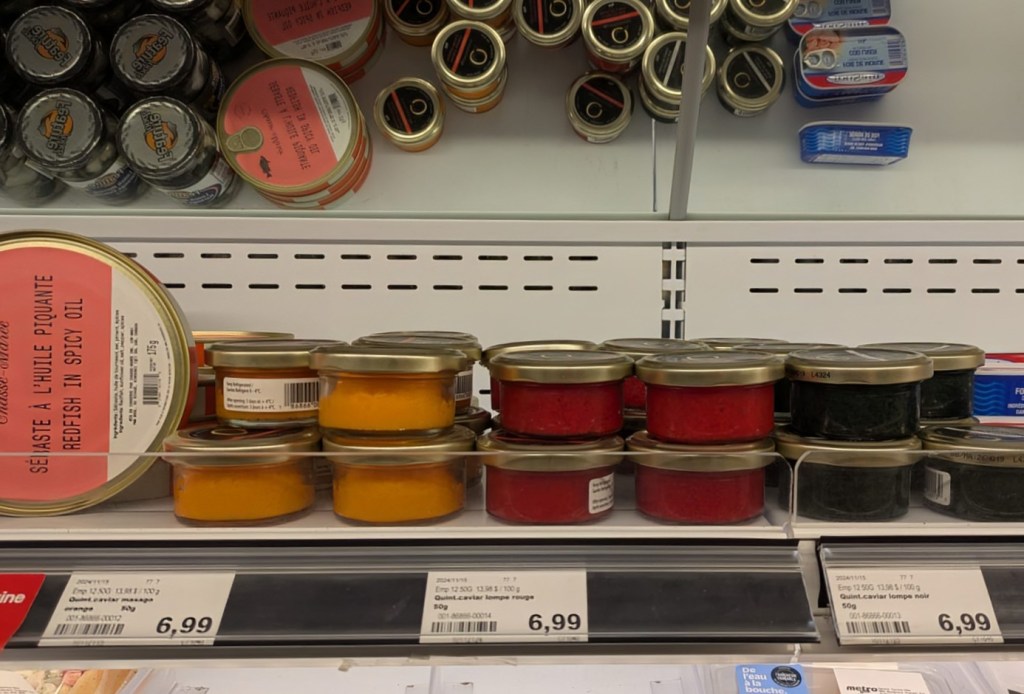
Still a hard “no” from me though.

Louder

We lived downtown in both cities, and we’re used to hearing a fair amount of shouting, singing, and laughing (especially on the weekends), but I think Québécois voices are literally just louder. Now we can hear the actual words being said, and even the volume of regular conversations here seems to be louder than what we grew accustomed to in Ottawa. Probably still not as loud as our country of origin, but a noticeable difference from the last two years nonetheless.

Colder, Windier, & More Humid

We had our suspicions about the weather being more extreme in Québec. I mean, we are further north and east, both of which usually get hit pretty hard, but we kind of thought we’d need a few months before we noticed if it was really much different. Turns out, we didn’t need long at all. The added humidity and constant wind means that the same temperature feels quite a bit colder. We keep seeing temperatures slightly above freezing, and then step outside only to realize that the real feel is significantly lower. Damp, windy cold is definitely tougher.

Snow-ready

Of course, both Ottawa and Québec are great at handling large amounts of snow, but it seems that they tackle the problem in different ways. Ottawa LOVES salt. The city and its inhabitants go hard on salting everything. Québec uses a mix of salt and sand, meaning that things are a bit slushier here. And maybe for that reason, it’s really common for buildings and houses here to put up tents in their driveways/entryways to keep the slush (and additional shoveling) at bay.

So that’s what we have on our list so far, but as usual, we plan to keep learning and sharing as we go. I’m sure by now it’s pretty apparent that these little differences are one of our favorite things about moving to a new place. Even one province over, there are just so many things to observe! How cool is that?

The Land of Chinggis and Cheese

22539874_10214836217407295_5943789659213220756_n
Sunset in Ulaanbaatar

Where exactly is the land of Chinggis and cheese, you ask? Mongolia, of course! Although truth be told it should really be “dairy” as opposed to “cheese”, but then the alliteration is completely lost. The Chinggis part (which refers to the Mongolian spelling/pronunciation of Genghis, as in Genghis Khan) is extremely accurate though. Between all the statues, pictures on the currency, and the multiple beer and vodka brands that bare his name, he is well-known in his native land. Catchy titles aside, last week Tucker and I were lucky enough to spend six days in Mongolia, and I could not have been more impressed! Again (this is becoming too common for me!), I failed to think about my expectations before heading off to the “Land of Eternal Blue Skies”, but I know that what we experienced far exceeded whatever I had thought the trip would be. Even with almost zero planning on our part, each thing we decided to try in Mongolia turned out better than we could have imagined, and Tucker and I came away from Mongolia with so many unique memories and experiences that will truly last a lifetime.

22448483_10214826002711934_3132479512147813780_n
     I promise I was working.

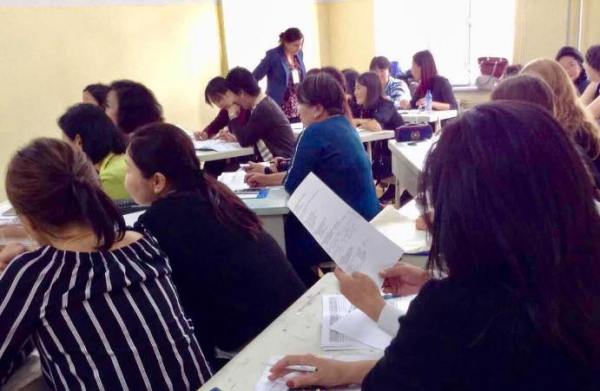
I should start this post by saying that my time in Mongolia was first and foremost work-related. I was able to travel to Mongolia in order to give a teacher-training workshop at the University of Finance and Economics as well as to attend and present at the local TESOL conference in Ulaanbaatar. However, to say that work things were my ONLY motive would be completely false. I really wanted to tourist around Mongolia – and I did! Apart from the professional experiences, which were phenomenal by the way (I met such great people and had a wonderful time exchanging ideas with fellow English teachers, not to mention an epic mini-reunion of Fellows), I was able to carve out some time for exploring the city of Ulaanbaatar, trying some of Mongolia’s traditional dishes, and even taking a road trip out of the city. To choose a favorite moment, or even activity, from our trip would be impossible, but here are a few things that stuck out:

22519425_10214825946150520_1137707689270684004_n
Flight into Mongolia

Our Arrival: Tucker, who is not easily impressed, is still talking about our flight into Ulaanbaatar. The city itself lies in a valley and is full of colorful buildings that range from small circular gers (the traditional round houses also known as yurts) to sleek and shiny, new skyscrapers. Around the city are snow-covered mountains, which with very little vegetation give a stark and geometric feel to the land. Beyond the mountains are the desserts, orange sand stretches as far as you can see from the window of a plane. It really was a beautiful sight, and something I haven’t seen on any other flight. Another thing we noticed upon our arrival was the thorough mixing of cultures. There was text in traditional Mongolian script as well as both the Latin and Cyrillic alphabets. We saw Italian and Mexican restaurants (MexiKhan might be the best pun-based name out there!), German brewpubs, and plenty of American brands/chains as well. After time in China or even the US, where authentic, foreign brands are sometimes hard to come by, it was a pleasant experience to see such a mix. We also noticed the strangeness that came with using Facebook and Instagram to connect with people again, as opposed to WeChat. China has pretty successfully occupied all my thoughts in the last two months, and stepping into Mongolia was almost like stepping back into something a little more familiar.


All the New Knowledge: Although, Mongolia wasn’t quite that familiar as it turns out. On our first day in the country I had to give a presentation during which I had placed my backpack on the floor. Oops – mistake! I was quickly told that’s a bit of a faux pas in Mongolia, and that the other teachers definitely noticed. Another fact we soon learned was that to bump someone’s shoe is a sign of disrespect, and even if it’s done accidentally, you should offer to shake that person’s hand as a sort of truce. Other facts I learned about Mongolia include that their entire country has less inhabitants than the city I live in in China, the language sounds a little more like Arabic than Chinese or Russian, and that lamb/mutton is the most commonly consumed meat. In addition to lamb, Mongolians seem to have an affinity for dumplings, as there were many different types to choose from: the fried kuushuur and boiled buuz, for example.

22449913_10214825948990591_6402485344895430020_n
Mongolian dumplings

Many had a slightly Chinese flair to them, but the addition of cheese was completely new to me. Another Chinese favorite, milk tea, turns out to be a bit different there as well: it’s salty instead of sweet. And then there’s the bone game. On our tables at several restaurants we found small, felt boxes with four ankle bones inside. The bones are rolled like dice, and the results are read from a list, which can predict your future. We saw fortunes like “will be happy and content” and also ones like “no hope”. Haha!

22406465_10214825973711209_7004512332451059323_n
Road Trip!

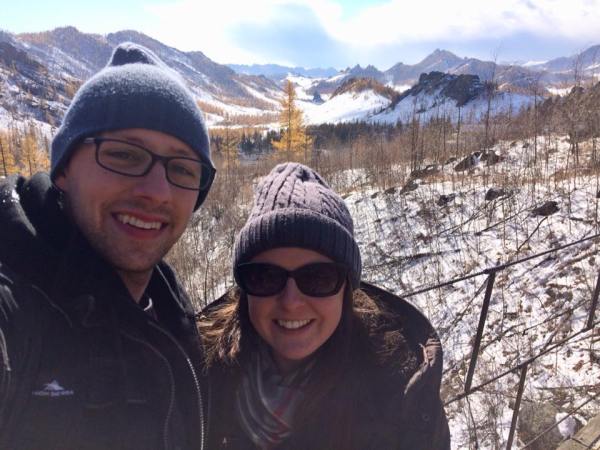
The Nature and Climate: I mentioned what it was like to fly into Ulaanbaatar, but the most beautiful scenery we came across lay outside the city. On our second full day in Mongolia, we went against several people’s advice and rented/drove a car outside the city. While I was extremely nervous for Tucker to drive in a place with a slightly different driving situation (most roads are not paved, steering wheels can be on the right or the left side of the car, and lines on the road are completely meaningless), I’m so happy we braved it and drove to Terelj National Park. The park and the landscapes on the way there and back were absolutely breathtaking. Flat sandy plains (complete with yaks), rocky mountain formations, a few sparkling rivers, and the snowy mountains in Terelj were all beautiful.

22449998_10214825977671308_4583572230516584826_n
Terelj National Park

Also, they are not kidding about the blue skies thing; they were by far the bluest skies I’ve ever seen (and yes, I’ve been to Montana). I was also incredibly happy to be in a colder climate again! Hefei, Orlando, and Atlanta – the last three cities in which I’ve lived are way too hot and humid for my taste. Mongolia was simply cold, and I loved it! We saw several flurries during our time there, and I relished my time in big, fluffy jackets, scarves, and gloves.


22528499_10214825972071168_2626382383470064556_n
Pretty epic, no?

Overall it was an incredible place to visit, even for just a short time. The people we met in Mongolia, including the hostel staff, the car renter, the teachers I encountered at the conference, and even the strangers who approached us in the street (looking to practice their English, of course), were all incredibly friendly and helpful, and we’d like to offer them our sincerest “bayarlalaa” (thanks). I highly recommend traveling to Mongolia if you ever get the chance! It’s very high on my list to re-visit, and I hope that happens sooner rather than later!


First(ish) Impressions of China and Its People

21766619_10214628768221195_7678037280271538335_n (1)
Garden at Anhui University

A couple of years ago I was writing a very similar post about a very different country, but now that we’re in a new city (in a new country and even on a new continent), I think it’s time for another sharing of our first impressions. Honestly, it can be really hard to write about these impressions! They come all at once (immediately upon arrival) and are quickly forgotten as we try our best to assimilate and adapt to our new lives; however, some things are definitely sticking out as we grow more familiar with China. My plan is to share everything I can about our time in Hefei, China, such as our impressions, experiences, and reflections, mostly because everyone seems to have a lot of questions about China (including the Chinese themselves – I can’t tell you how many times I’ve already been asked how the Chinese are viewed in the US). Of course, China is a massive country (much like the US) and as such, no one person can truly sum up what it’s like to live here, but I’d like to add to our collective knowledge by sharing a few things (in no particular order) that have stood out to us during our first month living in the Middle Kingdom.


21617611_10214628780741508_4114303479683282379_n (1)
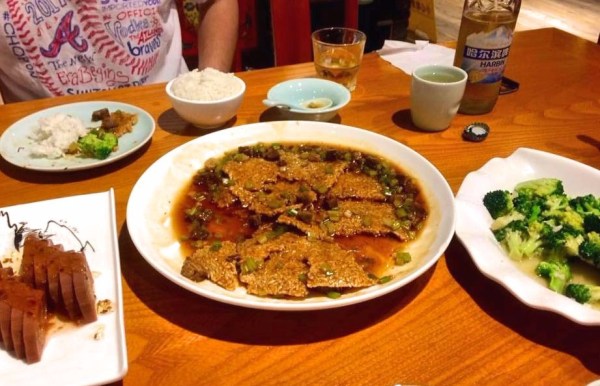
Lunch of crispy rice with sauce, garlic broccoli, and lotus root

Variety in Everything: As I mentioned, China is a vast country with a very long history, and for these (and likely other reasons), there is just SO MUCH. I’ll start with the food. Every menu has about a thousand options (not really an exaggeration), and the typical ordering style for a table is to get a few dishes and share everything. Basically the options are limitless! We find ourselves asking a lot of questions about the different dishes because really there are just so many, and, of course, Tucker wants to try them all! However, our Chinese experts (i.e. local friends) don’t seem to focus on the dishes themselves, but rather on the styles. They’ve explained that China has “four cuisines” based on different regions of the country: the spicy Sichuan, salty Shandong, fresh Huaiyang, and light Guangdong, which brings me to the next point: geography. Coming from the US, I know what living in a big country is like. I thought I knew what living in a geographically diverse country was like, but China knows the extremes. The world’s tallest mountain and a good portion of the Himalayas reside partially in southwest corner of the country. China also has the fifth largest desert in the world (the Gobi), Hainan Island (the Hawaii of the East), two of the world’s top ten longest rivers (the Yellow and the Yangtze), and a mainland that stretches into both tropic and subarctic climates! But variety can be heard as well as seen throughout China. It’s a little harder for us to observe, however, since we know very little Chinese (so far!), but we have noticed that communication can be difficult even for two natives. For example, on a bus an older woman asked a question about us to one of our Chinese friends, and our friend was unable to answer her. We asked what the woman had said, but our friend didn’t know. She said the woman spoke in the Hefei dialect that she couldn’t understand. But we’re in Hefei! Who can understand her if not other Hefeians?! This doesn’t bode well for our communication prospects.

21765289_10214628783021565_3940795605351965642_n (1)
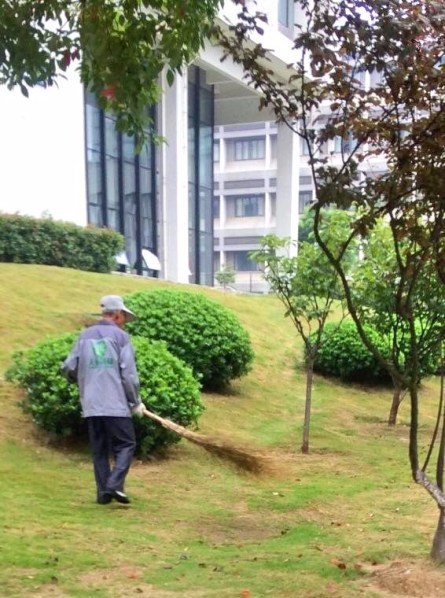
Bamboo broom

Mix of Old and New: Another interesting observance is the incredible mix of old and new that we see on a daily basis. China has been rapidly developing over the past twenty years, and I think it’s evident in this phenomenon. Walking around the city, it’s pretty common to see people sweeping the street with handmade bamboo brooms, while talking on their iPhone 7. We can also watch high speed trains whiz by us on one side, not making a sound, and on the other side a massively overloaded wooden cart delivering materials through puffs of smoke. To me it seems like a country that can have whatever modernity it wants, but maybe feels like, what’s the point if this way has been working for the past hundred years. Another example of an odd mix of old and new comes in the forms of payment used, and is actually a challenge we’ve experienced before. When paying for things like groceries, bus tickets, food, etc. you can either go old school or very new school, but nothing in between (which, coincidentally, is where the US lies on this front). In Poland you pay by either cash or tap cards, and in China, it’s either cash or phone app. What happened to paying with credit cards? Who knew that was such an American thing?!

21686194_10214628779421475_3972250096952986060_n (1)
We spent over 8 hours in this room.

Organizational Differences: I’d be remiss if I didn’t at least touch upon the different organizational style of China. Again, it’s early on for me to try and explain what is actually happening behind the scenes, but I can notice how at my level things seem to be done very differently. There are small things like the absence of lining up and taking turns, which honestly, has helped us out in a few time-sensitive situations (apparently cutting should be for those in need). However, it also makes it pretty obvious who the foreigners are (of course, that’s already pretty obvious in our case). In addition to queuing vs. crowding, I have noticed that people stand MUCH closer to me than I would prefer. Granted, I know I enjoy a pretty big personal bubble even by American standards, but I have honestly been a little freaked out by the face proximity of some of my students asking questions after class. Another difference we’ve encountered quite a bit this first month is the concept of collective hierarchies. Generally in the US, at institutes and companies each person has their own authority over something, be it small things like paperwork or large things like hiring/firing people. In China, it seems very few people (perhaps no one) has authority alone. There are almost always several offices and multiple employees involved in everything; even a seemingly simple classroom change request required six stamps, four separate offices, and three signatures. China really has a complicated system of checks and balances, which when coupled with a lack of Chinese, can be a tad frustrating to wade through.

21766544_10214628768341198_7535584597151519785_n (1)
A colleague and me touring the old campus

Helpfulness of the People: Finally, the most evident impression I have of China is that this is a land of helpful people. To say that we’ve needed a lot of help in getting set up here in Hefei would be a drastic understatement! From bank accounts to medical exams to renting shared bikes, with very little English around us (and Chinese being impossible to read as a beginner), we’ve had to rely on many people that we’ve only just met. And they have absolutely addressed every need/wish we could have possibly imagined. We’ve had colleagues, friends, and random graduate students at the university accompany us on so many long, mundane tasks. On their days off they offer to sit in the bank with us for hours (multiple times), take extremely long bus rides to the train station in order to register us (which we still haven’t been able to accomplish), walk with us through our first trips to the grocery store while we argue about which sheet set we want, and so much more. I honestly don’t know why they keep offering their help!

21742851_10214553839908034_5436392174360508316_n (1)
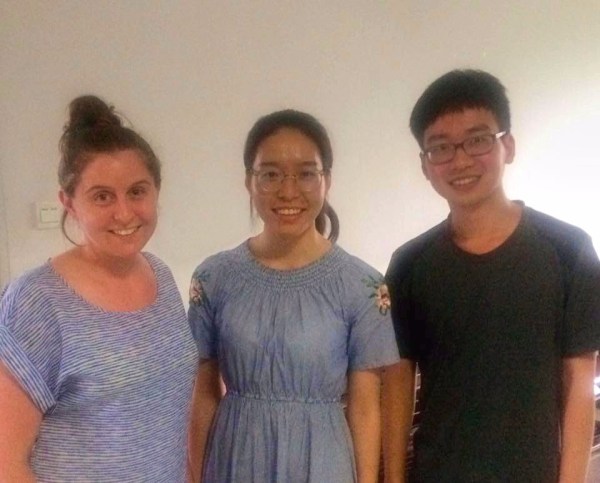
Three tired friends after a long day of errands

We’ve surely put them through some terrible experiences, and at the very least sheer boredom! But they do come back; they want to help; they want us to enjoy ourselves in China no matter how much time and energy it might cost them. Even strangers have been helpful in whatever ways they can. We’ve had people help us order food, show us the way when we’re lost, and even just listen to our terrible Chinese, trying harder than most to really understand us. It can sometimes feel isolating, not being able to talk to people, but so far, we’ve felt pretty well-connected, regardless of language barriers.

21618000_10214628764421100_5879971110442231985_n (1)
Living the life!

And so the record of our first impressions of China is complete. Overall we’ve had an amazing first month (albeit confusing at times), but truly, even after contemplating my expectations beforehand and reflecting on our last trip to China, our impressions still differ from what we thought. The feelings we have are just different somehow. Maybe it’s because now we’re not just thinking of the country, but also the people and connections we’re making. Of course, sometimes we do get frustrated and the ambiguity we endure could probably stretch the length of the Great Wall, but it honestly doesn’t feel that different from living in the US or in Poland. People are people, and some things are just always frustrating (paperwork, for example).