

It’s October, a strange time of the year where spooky and supernatural things are dressed up in costumes and set out on suburban lawns. Truth be told, Halloween really isn’t my thing. I don’t like scary movies or unexpected visitors, and as I have chocolate in the house year-round, even the candy aspect is a bit of a miss. What I do like, however, is a nice dose of cultural quirks. Therefore, in lieu of ghosts and goblins, this month, I’m sharing my favorite international superstitions, all of which I’ve either heard from my students and/or have experienced myself abroad. Nothing creepy or crawly here, I promise!
The first superstition I thought of is a simple one that I experienced often when I was in China. Much like how we view the number seven as lucky and the number 13 as unlucky, the Chinese, too, have their superstitions regarding certain numbers. One of the strongest of these is about the number four. The number four is generally avoided in China. Elevators will often skip that floor number altogether, and any room numbers or phone numbers that happen to have too many inauspicious fours in them are often shunned as well. So, what makes the number four so unlucky in China? It’s actually the pronunciation of the word. In Mandarin the number four is pronounced [sì], which is unfortunately similar to the word [sǐ] or “death”.

Speaking of death (it is Halloween after all…) in South Korea, a common superstition is that sleeping in a closed room with a running fan might actually kill you. This is such a common superstition that “fan death” has its own Wikipedia page. Although the alleged cause of death for these unexplained casualties has never been proven (or even agreed upon), warnings are still commonplace throughout the country. Bet you’ll never look at that unassuming appliance in the corner of your room the same way again!
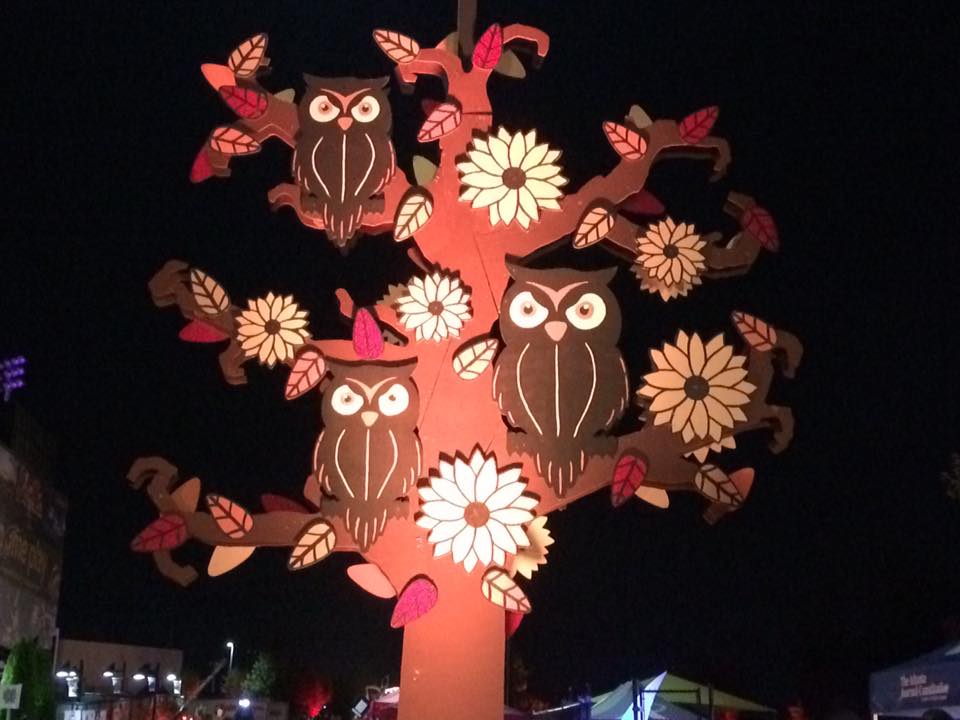
Another death-related superstition I recently heard comes from Kenya, where owls are actually seen not as wise, candy-crunching mentors, but instead as harbingers of death. Seeing an owl in Kenya is believed to be a bad omen because it means that death will strike soon. Could be you, could be a family member, but you can be sure it’ll be close and quick. Even the local words used for “owl” are often avoided as they might bring about the birds themselves (and subsequently an untimely death). Perhaps Hedwig was the true cause of Harry’s continued misfortunes…
Bad luck is understandably a pretty common thing to be superstitious about, but my favorite superstitions involving bad luck are the ones that can be traced back to an event or custom in a culture’s history. One example of this would be the fact that it is considered unlucky in France to eat a baguette or loaf of bread that has been kept upside down. This belief is said to come from an old practice of leaving upside-down bread loaves out for the town executioner to pick up. No one would want to anger an executioner by accidently eating his bread, right?
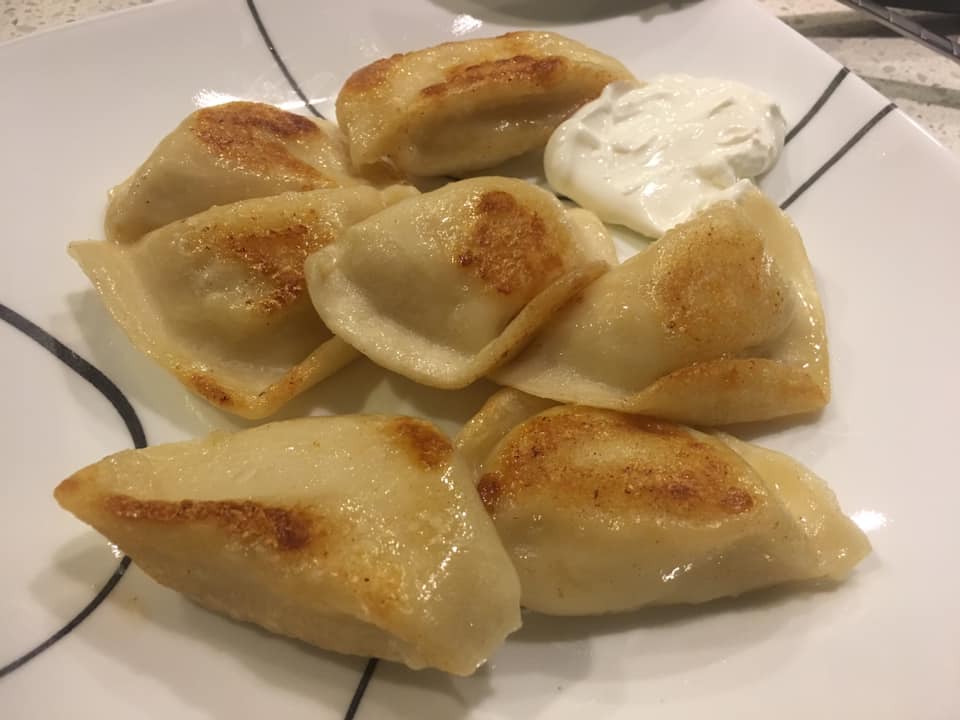
Two other superstitions that come to mind when I think about bad luck come from Poland and Mexico. In Poland, we were told not to count any perogies that are being cooked. It’s simply bad luck to do so, and it may result in a ruined dinner. In Mexico, to escape a bit of bad luck, you should avoid sweeping at night because that, too, can bring a curse down on your house. Additionally, even when daytime sweeping in Mexico, you shouldn’t sweep the dirt straight out your front door, otherwise all your good luck will leave with it too. I knew I should have swept it under the rug instead!
If bad luck to you means losing money, then you shouldn’t put your purse or wallet on the floor. In Brazil (and many other countries) this action or even the accidental dropping of your purse/wallet could mean that you’re about to lose a lot of money or else have some other, serious financial difficulties.
In addition to good and bad luck, many other superstitions seem to be concerned with friends and enemies. For example, in Mongolia if you happen to touch someone’s foot or step on their shoe, you should immediately shake hands as a sign of good faith and friendship. If you do not, it means that conflict is on the horizon and that your relationship might be strained in the future. This superstition is so prevalent that even strangers who accidently bump feet will turn and shake hands to combat the negative consequences.

In another shoe-related superstition, in Egypt, it is considered disrespectful to leave your shoes with their soles facing up. Stemming from ancient Egyptian beliefs, this can be seen as a slight against God, thus a possible omen of bad events (or in a mixing of religious terms, bad karma) heading your way. This superstition also seeps into etiquette because it is also seen as rude to sit with your soles pointing towards another person.

In Turkey, it’s sharp objects (or at least passing them to others) that can cause you to lose friends. For example, handing over a pair of scissors might been seen as the cause of a severed relationship in the future. It’s more prudent to set the sharp things on a nearby table than to hand them over directly.
On the other hand, if you find that you want to get rid of an unwelcomed friend, or a visitor that has over-stayed their welcome, in the Philippines, there is a superstition that says sprinkling salt around your house will cause a visitor to leave. I wonder if you throw salt over your shoulder at the same time will the results be magnified or canceled out?

Other common superstations revolve around mystical creatures and the magic they bring. In Peru, dragonflies are believed to be connected with sorcery and can bring evil to those whom they touch. Luckily, also in Peru, ladybugs are counters to the devious dragonflies, and they can indicate that good luck is on the way.
Some creatures, however, can be related to both good and bad superstitions, as with the Icelandic elves. These “hidden people” are woven into many beliefs and even holiday celebrations in Iceland. For example, there are stories about construction projects being halted because the plans didn’t take into account the feelings and habits of the local elves. They really must be consulted if you want things to run smoothly. I’ve also heard they throw some pretty awesome Christmas parties.

And there you have it! A well-rounded 13 international superstitions to keep you up at night wondering how many times you brought the bad luck on yourself with your unsuspecting actions. Perhaps this explains all the bad juju in 2020? Something to think about! Happy Halloween! 😉
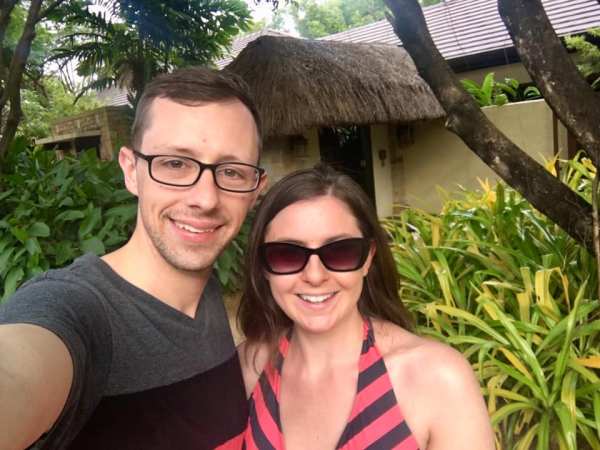 The second New Year (also known as the Chinese New Year or the Lunar New Year) has come and gone, and with it, possibly our last long winter break off together. Just like last year, the Chinese university semester break coincides with the holiday giving us several weeks off, which, of course, we put to good use! My program had its mid-year meeting and conference in the Philippines this year, and somehow, Tucker and I managed to squeeze in three (and a half) other destinations on our island hopping itinerary. You might have seen the hundreds of photos on Facebook, but I’d also like to share a few words about our time traveling in South Asia. To be honest, it’s a little surreal to be writing this as I watch the snow fall outside, but here we go!
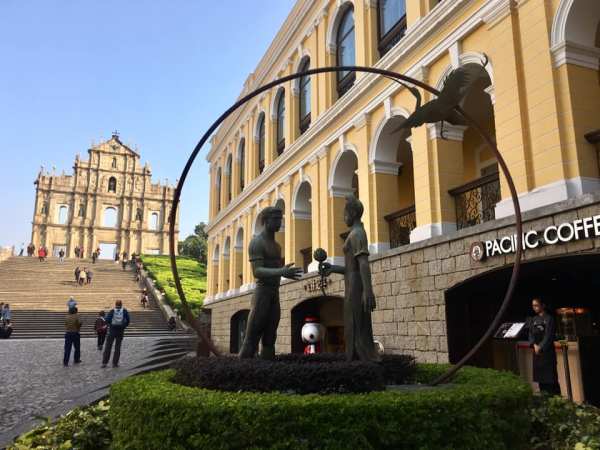 Our first stop was Macau, a “special administrative region” of China. It gets this rather long name due to it being somewhere in between a province and another country entirely. It’s a part of China, but it’s also not China, which is actually one of the reasons we wanted to visit. We wanted to see if there were any noticeable differences. We also wanted to visit because we were eager for another taste of Portugal. Macau used to be a Portuguese colony and has retained quite a bit of the Portuguese flair in architecture, food, and language.


 After a few days of strolling around Macau’s narrow alleyways, we took a massive speed boat (TurboJet) to our next destination just across the water: Hong Kong. This was actually our second trip to Hong Kong, but last time we didn’t quite get to everything on our list – this short stopover on the way to Midyear was our second chance. We had less than 24 hours in the city, but we managed to make it out to Lantou Island to see the incredible Buddha and cableway there, we took the bus to the top of Victoria Peak to watch the sunset over the city, and we went to Tim Ho Wan for the world’s cheapest Michelin Star eats. While I definitely preferred Macau’s laid back, European vibes, it’s hard to not like Hong Kong as well. Macau and Hong Kong are a couple of tiny islands (and respective peninsulas) that I highly recommend everyone to visit! No visas needed for US citizens! :)
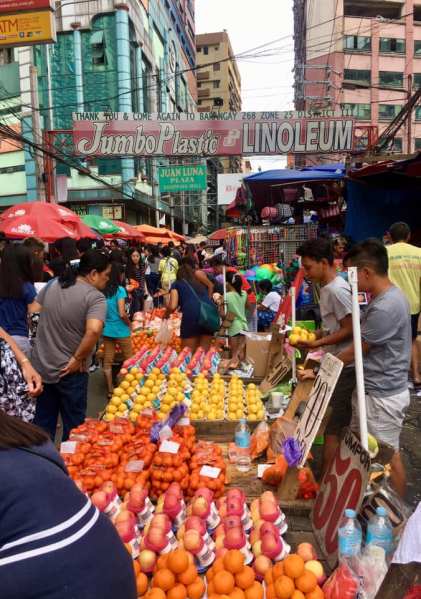 All too soon it was time to fly to the Philippines and get to work. When we first landed in the Philippines it was chaos! Passengers getting up and grabbing their bags before the plane had stopped moving; people sitting on seemingly every inch of the floor in the airport; signs for flight changes being moved by hand from gate to gate; loud cover songs of 2000’s hits playing in every corner of the terminal, etc. All I could think was “Well, we’re definitely not in China anymore.” As we sat waiting for our flight though, the newness wore off, and it was easy to see that the Philippines are just plain fun! In fact, their national slogan is “It’s more fun in the Philippines”, and I totally got it. Smiles were everywhere! The flight attendants wore bright yellow polos and hummed songs as we boarded. Fellow passengers sang along with the music they heard on the plane. The joy was contagious!
 The first week we were in the Philippines I had to “work”. I attended meetings with the other Fellows, we planned and executed various group activities, and generally bonded and reconnected after our last five months apart in our various host cities/countries. For this part of Midyear, we were put up in a resort on Mactan Island, which was incredibly fancy and not the sort of place Tucker and I usually go for (I’ve never heard so many “yes ma’ams” and “hello sirs” in my life). It was beyond beautiful though, and luckily Tucker was able to take full advantage of the beach, the snorkeling, the infinity pool, etc. However, after a few days completely devoid of local culture, I was definitely ready to get to our next location: Cebu City. It was here that we attended and presented at a local teacher training conference held at the University San Jose Recoletos. Easily my favorite part of Midyear, I was able to meet and interact with many local Filipina/o teachers and get a much better feel for what life in the Philippines is really like.

 Once the conference and Midyear were officially over, Tucker and I hadn’t quite had our fill of the Philippines, so we headed to Manila for some good old-fashioned touristing. Manila is an incredible city with some of the best food I’ve had in a long while. Their specialty seemed to be fusion restaurants. We had super interesting and delicious food at Loco Manuk (Filipino, Peruvian, and Chinese) and El Chupacabra (Filipino and Mexican), and saw a Japanese-French Cafe that looked amazing as well! In addition to the incredible food, we also had a great time walking around Manila Bay, grabbing a drink in Intramuros (the Old Town), and watching the Super Bowl at a local expat bar. The Philippines boasts an amazing mix of languages and cultures, and it was so fun for us to be able to use English (commonly spoken there) to ask about a million questions of our taxi drivers, servers, and any other local we could find. We learned about the strong influence of Catholicism in the Philippines, the new-ish movement towards environmental clean up, and most of all, we learned how welcoming and friendly the people are.


 At this point we were over the halfway mark of our trip, and my body had had enough. I left Manila with a fever and several other ailments (not so fun to describe), but I was still super excited to see Singapore! We watched Crazy Rich Asians on another leg of this trip in preparation, but the movie doesn’t do the city justice. It is by far the cleanest city I’ve ever seen, and has represented its multicultural population incredibly well! Singapore is made up of large groups of ethnic Chinese, Malays, and Indians, and each has a dedicated area of the city where you can find their respective religious buildings, restaurants, and specialized grocery stores. Even with the diverse neighborhoods in place, the city as a whole really seems to cater to each group in so many ways. Colorful, artistic, and clearly very well-off, there are so many lovely parks and public spaces in this city, where we saw families wearing everything from tank tops and sundresses to saris and hijabs. I often talk about places where there is a mix of cultures, but its usually a watered down mix, where clearly one culture has dominated, but in Singapore they were all there loud and proud. It was amazing!


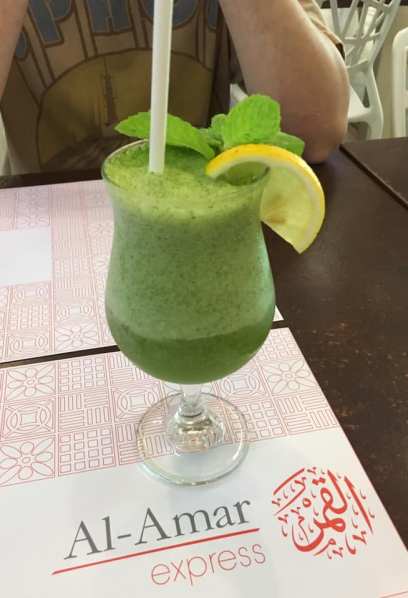 It turns out KL was full of surprises for us. The majority of people living in Malaysia are Muslim, so it was much more conservative than I was expecting. Most everyone wore long sleeves and pants despite the high temperatures, and the presence of beautiful and delicious “mocktails” was at an all time high for me. KL is actually not on an island, and to us, it seemed like we lost that friendly, carefree island-vibe as soon as we arrived. Interactions were a bit more abrupt and businesslike – like they usually are, I suppose. Another surprise was the color we saw all around us – both the Philippines and Singapore were incredibly colorful cities, but I think any city would be hard pressed to match the vibrancy of KL. Brightly colored murals everywhere, some of the lushest, greenest trees I’ve ever seen against the bluest of skies, and the insanely colorful Batu Caves just outside the city made for some incredible scenes (and photos).


 Dani Francuz Rose