
Learning another language is truly a challenge like no other! It’s all-encompassing and never-ending, and if you choose to learn a non-standard variety, like, say, Quebec French for example, it can sometimes feel like you’re learning two languages at once. For example, in class, I was taught words like “chaussure” (shoe) and “portable” (cellphone), but in the streets of Québec City, I hear “soulier” (shoe) and “cellulaire” (cellphone). Of course, I’m all for linguistic choice, but as a proud Quebec resident, I feel the need to learn, use, and share the dialect of my new home, so with that in mind, I give you a few of my favorite Quebecisms:
Char
Standard French: voiture
English translation: car
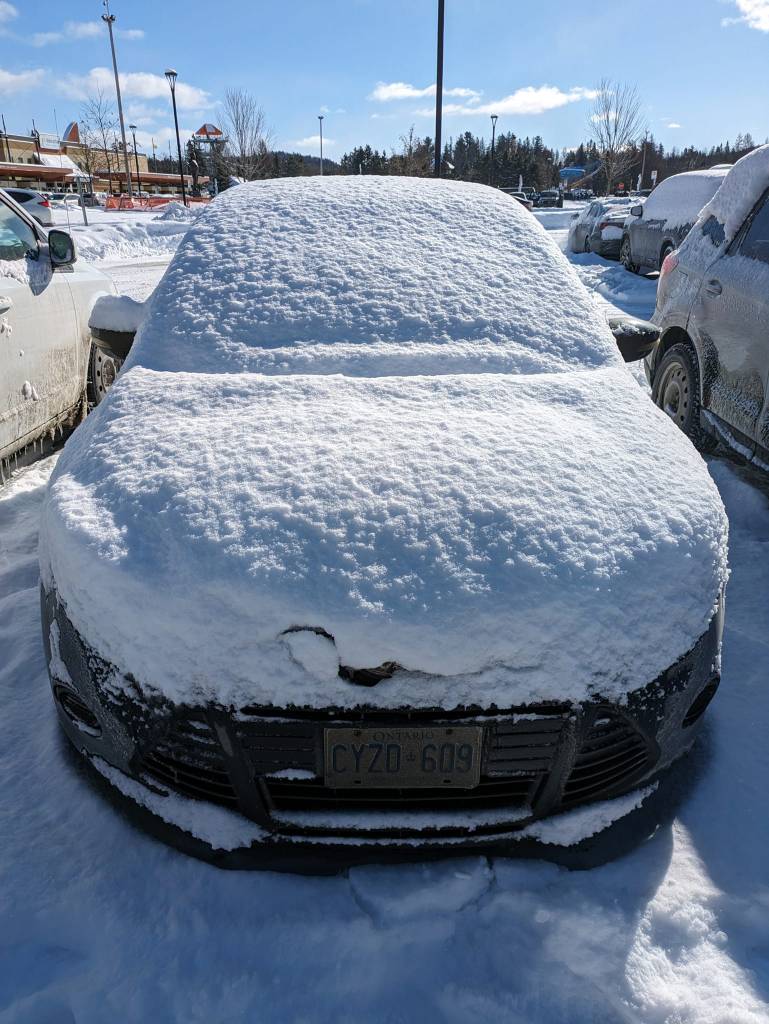
First up is the use of “char” for “car”, and I know what you’re thinking, this has to be English influence at work, but no! “Char” was actually used in Old French to refer to chariots, horse-drawn carriages, two-wheeled carts, and the like. In Quebec, “char” happened to stick around, whereas in France people started using “voiture” for wheeled vehicles and “char” specifically for heavy-duty vehicles like tanks. I’ll be honest though, even our little Ford Focus feels a bit like a tank when busting through the snow banks of Québec City! Maybe it’s not such a big difference after all.
Blonde/chum
Standard French: copine/copain
English translation: girlfriend/boyfriend
Another Quebec classic is the use of “blonde” (regardless of actual hair color) and/or “chum” to refer to your significant other. I say “significant other” because most of the time they’re used for girlfriend/boyfriend, but there’s actually some flexibility there; your fiancé or even your husband could be “ton chum”. Of course, “chum” can also refer to just a friend (of any gender), which isn’t confusing at all, n’est-ce pas?

Il fait frette
Standard French: Il fait très froid
English translation: It’s really cold
Sometimes, necessity is the mother of invention, and in French Canada, the harsh climate has led to many inventions, including some of the linguistic sort. Here, we often experience stretches of -20° temperatures, where “cold” doesn’t quite cut it. So, when it’s Quebec cold aka really cold, we can say “il fait frette”, which means you had better be wearing multiple layers!
Sloche
Standard French: neige fondante
English translation: slush
In addition to the temperature differences between Canada and other Francophone countries, we tend to get a lot more snow over here, and like other snow-dwelling peoples, we need to be able to differentiate between the many different types of snow. Enter the word “sloche”, which refers to the nasty grey sludge that appears after the snow and ice start to melt. Known as “slush” in English, this one probably did come to Quebec via English influence, but the English actually got it from the Scandinavians, so it seems sloche is just a fact of life for all northerners!
Paparmane

Standard French: pastille de menthe
English translation: peppermint
Speaking of English influence, I think one of my favorite examples of phonetic borrowing might just be “paparmane”, which is how Quebecers nativized the English word “peppermint”. I love this for two reasons. For one, I’m always ecstatic when there’s a one-word alternative available in French (somewhat of a rarity!), but I also love it because it highlights just how different the respective orthographies are. If you could only see the way I’ve spelled some Quebec place names prior to seeing them written down… Oof! “Paparmane” is way closer than I ever get!
Jaser
Standard French: bavarder
English translation: to chat
“Jaser” is another Old French word that simply went out of favor in Europe, but is still hanging on in Canada. Here it just means “to chat”, but in France, “jaser” is associated with gossiping and has more of a negative connotation. Interestingly, the word used more commonly in France now is “bavarder”, which comes from a word that meant “saliva” or “drool”, which seems a bit negative in its own right, but what can I say? Language is compliquée.

Aweille
Standard French: allez
English translation: let’s go
“Aweille”, which I’ve also seen written as “enweille”, “awèye”, and even “enwoye” is a very useful Quebec creation for whenever I find myself trying to get my dog to hurry up and go pee already! It has such the perfect combination of sounds for whining, which is my preferred usage, but it can also be used in a more encouraging way like “Come on! Let’s go!” Aweille! There are more Quebec expressions to learn!
Tiguidou
Standard French: parfait
English translation: okey dokey
Another super positive Québécois word is Tiguidou – positive and extremely fun to say, I might add! The origins of “tiguidou” are somewhat contested, but many believe it’s a borrowing from the British/Scottish expression “tickety-boo”, which honestly doesn’t help much for the Anglophones on this side of the Atlantic because what the heck is “tickety-boo”? Anyway, in Quebec, “tiguidou” is just a fun way to say “A-OK”. Et c’est tiguidou!
Tabarnak
Standard French: putain
English translation: holy shit
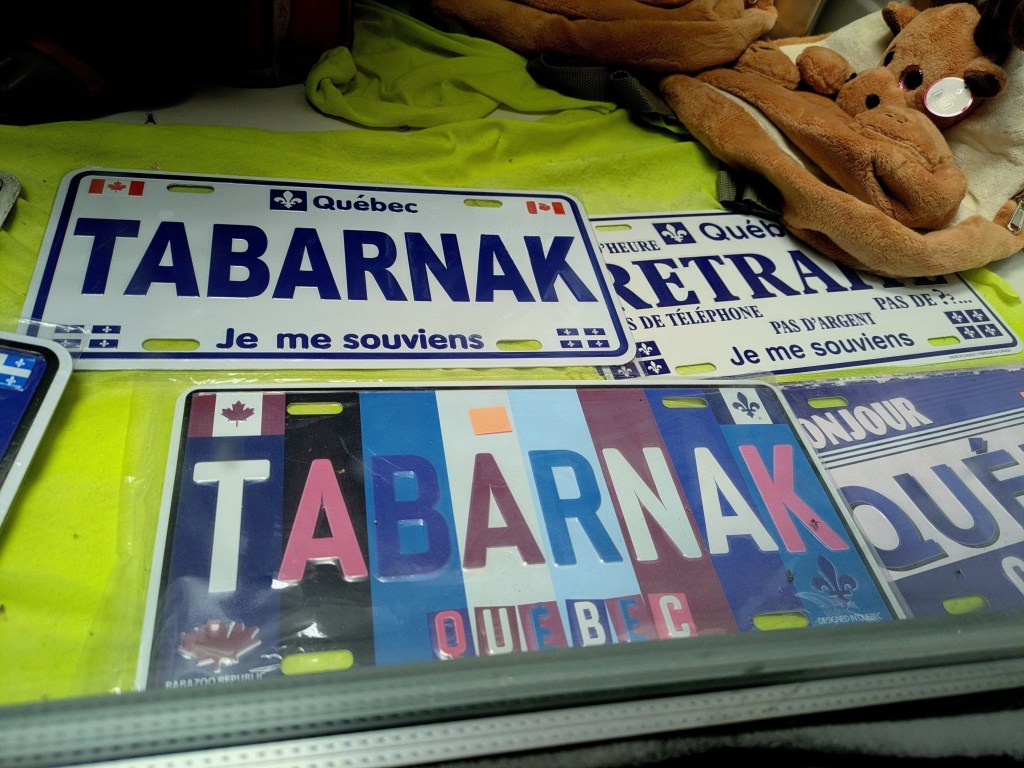
Of course, I can’t have a list of Quebecisms and not include the most famous of them all! A little warning though, if you’re not a fan of profanity, better skip to the next word because it’s impossible to talk about “Tabarnak” without swearing in multiple languages… To those still here, Quebec has a whole set of unique swear words that all have to do with the church, such as “Tabarnak” (which literally means “tabernacle”). Why is that a swear here? Good question! Unfortunately, this is the kind of thing that needs its own post entirely, so for now, you can just think of “Tabarnak” as a multifaceted, catch-all exclamation, not all that unlike the English “holy shit”!
Attache ta tuque

Standard French: accroche-toi
English translation: buckle up
Thankfully, I had already bolstered my Canadian vocabulary in Ottawa before relocating to Québec City, otherwise I might have been a little more confused upon first hearing “attache ta tuque”. Tuques are winter hats, so the phrase is literally saying “attach your winter hat”, but it’s used a lot like “buckle up”, as in, we’re in for something crazy here! Hang on your hats!
Tire-toi une bûche
Standard French: installe-toi
English translation: pull up a chair
I love this expression because it just feels so…colonial. It literally means “pull up a log” as in find an unoccupied stump and have a seat. It’s so easy to imagine early settlers, sitting around a fire in a circle made up of nature’s chairs coining words like “tiguidou” and “paparmane”. There’s definitely an ease to modern-day Quebec culture as well, and I think that’s why a phrase like this still exists. Tire-toi une bûche and let’s just jaser the night away!

L’affaire est ketchup
Standard French: c’est nickel
English translation: It’s all good
Last but not least, a phrase that I, as a ketchup-lover, just can’t get enough of! “L’affaire est ketchup” literally means something like “the thing is ketchup”, but it’s used as an idiom for “done deal” or “it’s all good”. The idea is that once the final touch of a little ketchup has been added, we’re all set; we’re good to go, which if you’ve ever seen me eat a hotdog, is a sentiment you know I take to heart!
So, there you have it! Just a few of the many colorful words and expressions that I’ve been learning as I strive to become one with La Belle Province! I hope you enjoyed them too! À la prochaine!
 Dani Francuz Rose