

This year has thrown a lot of surprises at the world (and some not-so-surprising events as well really), but for me and Tucker one of the most unexpected occurrences has been our prolonged stay in Florida. We were only meant to be here for a few months as we gathered our lives from various corners of the world in order to head north for the next few years. Of course, with a brief snag in our immigration paperwork followed by a global pandemic, we’ve found ourselves in a holding pattern since March. And while, like everyone else, I’m still struggling to figure out what this all means for our jobs, our future, our society, etc. I’ve also been doing what I do best in a new place: exploring. Even though this exploring has taken place mostly online (and occasionally from a socially acceptable distance), life in Florida has still been quite interesting, and in some ways enlightening. Thus, for this month’s post, I have put together a list of my newly gleaned facts (and opinions) to share about our temporary home.

The first thing I have to mention is the fact that everyone seems to have an opinion about Florida. People who have never even been here feel one way or another about it, and plenty of people like to vocalize their opinions (many of which are quite negative) without much regard to facts or feelings. I say this as a non-Floridan, someone who doesn’t have a strong feeling one way or another about this particular state, but sheesh, even I feel bad listening to the many tirades and verbal attacks on the Sunshine State, especially those that can be found online. In our brief time here, I’ve come to view Florida as the state that’s often picked on, but that everyone secretly likes and takes advantage of (like an annoying kid in school that has a really nice pool).
When reflecting on why there are so many negative associations with Florida and Floridians floating around out there, I feel it boils down to two things: 1) the Florida Man and 2) vacationers. Most everyone knows about the Florida Man trope nowadays. A long-lasting meme that has permeated the internet and beyond, it originally referred to the crazy headlines often found in Florida that always begin with “Florida man…” and usually end with his doing something absolutely absurd. But interestingly, one of the first things I learned about the Florida Man origins is that they were sparked by a change in state law. In the 1990’s Florida passed the Sunshine Law, which ensures public access to all government records, including police arrest records. As you can imagine, in 30 years, the spring break capital of the US has racked up quite a few crazy stories, which brings me to my next point.


Vacationers. Probably the first thing we noticed after a few months in Florida was the ebb and flow of the people. Renters in, renters out; snow birds in, snow birds out; spring-breakers in, and (thankfully) spring-breakers out. The state of Florida has approximately 22 million permanent residents, but sees 110 million tourists annually. That’s a lot of YOLOing for any place to deal with. I think I actually first noticed this phenomenon in grocery stores. People in bathing suits, vacation gear (lots of Disney paraphernalia where we are), and a general lack of care for their immediate environment. Many people are here for a short time and their mindset is to live it up; therefore, chaos ensues, sometimes in the form of drunken parties and possible police involvement (which is then publicly documented for all the word to see and share).

Of course, I completely understand why so many people choose to vacation to Florida. It’s an amazing place for affordable and varied entertainment. We’ve got theme parks all over the place: Disney World, Legoland, Universal Studios, SeaWorld, Busch Gardens, (and for a select clientele) Gatorland. There is also an abundance of parks, lakes, and other natural features like the Everglades, hot springs, swamps, and of course, the many, many beaches. Florida actually has the longest coastline of any of the contiguous states, and the climate (especially in south FL) means beach-going is possible year-round.


Speaking of South Florida, another thing that became immediately clear upon moving here was the presence of three distinct regions. You have North Florida, Central Florida, and Southern Florida, and the people who live (and vacation) in these three places often differ as much as the geography. We’ve heard this said a few times now: the further north you go in Florida, the further South you are. This refers to the fact that northern Florida is very much like Georgia, Alabama, the Carolinas, etc. Demographically, linguistically, socially, north of Ocala is really part of the South. On the other side, you have South Florida which held onto its Spanish roots and still welcomes a large influx of immigrants from Central and South America. The influence can be seen, heard, felt, and tasted as soon as you drive south of Lake Okeechobee. And that leaves Central Florida, which is somewhat a mix of the two and also somewhat the result of many retirees from out of state. Orlando and many other cities in Central Florida are very much like any other major city in the US: professional, progressive, and a tad hipster.


Another part of life in Florida that caught my attention early on was the naming of the coasts. Most likely, at least in part due to tourism, each section of the coastline in Florida has a name and, for lack of a better word, a vibe. You have the Space Coast, which is the location of the Kennedy Space center and where all the rocket launches take place (which we can see from our driveway, btw). You also have the Gold Coast where the big cities (Fort Lauderdale and Miami) and the famous South Beach are located. There’s the Sun Coast with its beautiful sunsets, the Nature Coast with its natural springs and manatees, and even the First Coast, which is where you can find the first and longest continuously inhabited settlement in modern day USA.
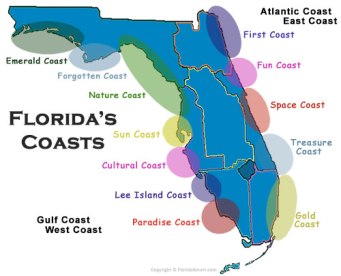

Since our trip to Saint Augustine and the First Cost, I’ve been really interested in Florida’s history and particularly how it differs from that of the colonies. Perhaps most people remember that Florida was first claimed by Spain, which is why we still see so many names like: Boca Raton, Punta Gorda, Buena Vista, etc., but what I (having taken Georgia History, not Florida History, in school) found super interesting was the native American history here. Of course, it now seems quite obvious with place names like: Tallahassee, Kissimmee, and Osceola, but I never gave much thought to the tribes that called Florida home and were actually some of the first to be attacked and displaced. Indeed, the Creek/Seminole tribes, in particular, not only found themselves stuck in the middle of a fight between Britain and Spain during the Seven Years’ War, but went on to challenge the US settlers with what is now known as the Seminole Wars, some of the longest and most expensive in early US history. Historically, Florida has seen a lot, and I don’t think it gets much credit for its important place in US history, let alone world history.

Finally, the last surprising fact I am very pleased to share is about the weather. As cold weather people, Tucker and I were very much dreading our time spent in the humid and, yes, extremely sunny Florida, especially as that time started to stretch into summer. However, I’m happy to report that it’s really not so bad! Florida is really breezy, which certainly helps with the heat, and now that we’re officially in summer, I can say that there’s a bit of a rainy season here meaning the afternoon thunderstorms that happen almost every day also help to cool it down. We’ve both commented that while the warmer temps might last longer, they don’t feel near as oppressive as summer in Atlanta. Plus, the produce here is absolutely amazing! In addition to citrus, Florida produces significant percentages of the country’s tomatoes, watermelons, cucumbers, and sugar cane.


All in all, Florida has been a surprise in many ways for us (including the very exciting news that there is no state income tax in Florida!). Ultimately, our time here has really just been another lesson in finding out how much there is to discover/learn, even in a place you think you already know pretty well. So, what have you learned so far in 2020?
 This month I turned 30, which of course has me reflecting. Reflecting on the now three decades of life I’ve lived, and perhaps more importantly, on the three decades of lessons I’ve learned. I truly feel I learn something each and every day, and sometimes these lessons are what I consider to be “life lessons”, nuggets of advice that I try to take with me and live by, not just in the moments that test me, but throughout all the moments I’ve been given.
 Ask questions. One of the best ways I know to learn and grow is by asking questions. I used to be embarrassed to be the person who always had a question or two, but now I realize how valuable questions can truly be for our own understanding and for others’.
 There will always be someone _________ (insert comparative adjective here) than you. It’s no use chasing labels like “the best _______” or “the most _________” because somewhere out there someone will burst that bubble. We really shouldn’t compare ourselves because we’re just not the same.
 Find things that make you happy and do them often. So when you’re not working, find and do things that you like. Enjoy your hobby, spend time with people you love, take trips, do all the things!
 Stay positive. Especially right now, it can seem impossible to see the glass as half-full, but there’s always a silver lining and “happiness can be found even in the darkest of places” if you keep looking. Staying positive not only helps us get through tough times, but it allows us to move forward with hope for a better future.
 Some things don’t need to be said. Together with thinking before acting, we should definitely also think before speaking. I’ve had to edit a lot of papers in my day, so I’ve learned the art of reticence. I really love the proverb: “Before you speak, let your words pass through three gates. Is it true? Is it necessary? Is it kind?”
 People are more alike than different. Another truth that makes itself known to me every day is that we are all more alike than different. It’s fun to share and learn from our little differences, like customs, slang, preferences, etc. But ultimately, we’re all human, and we’re so much better off together.
 Awareness and open-mindedness are necessary for growth. We simply cannot hope to improve or progress without awareness and open-minded thinking. It can at times feel uncomfortable or strange, but the end results can be truly life-changing.
 Be thankful and reflect on how/why. We all know we should be grateful for what we’ve been given in this life. It could always be worse, after all. Gratitude can really give us that big picture perspective and prompt so many other positive thoughts and actions in our lives.
 Not always having the answer is freeing. I have a motto: embrace ambiguity. It’s healthy to not have all the answers, and even healthier to recognize that we don’t.






 Dani Francuz Rose