Québé-Quoi?

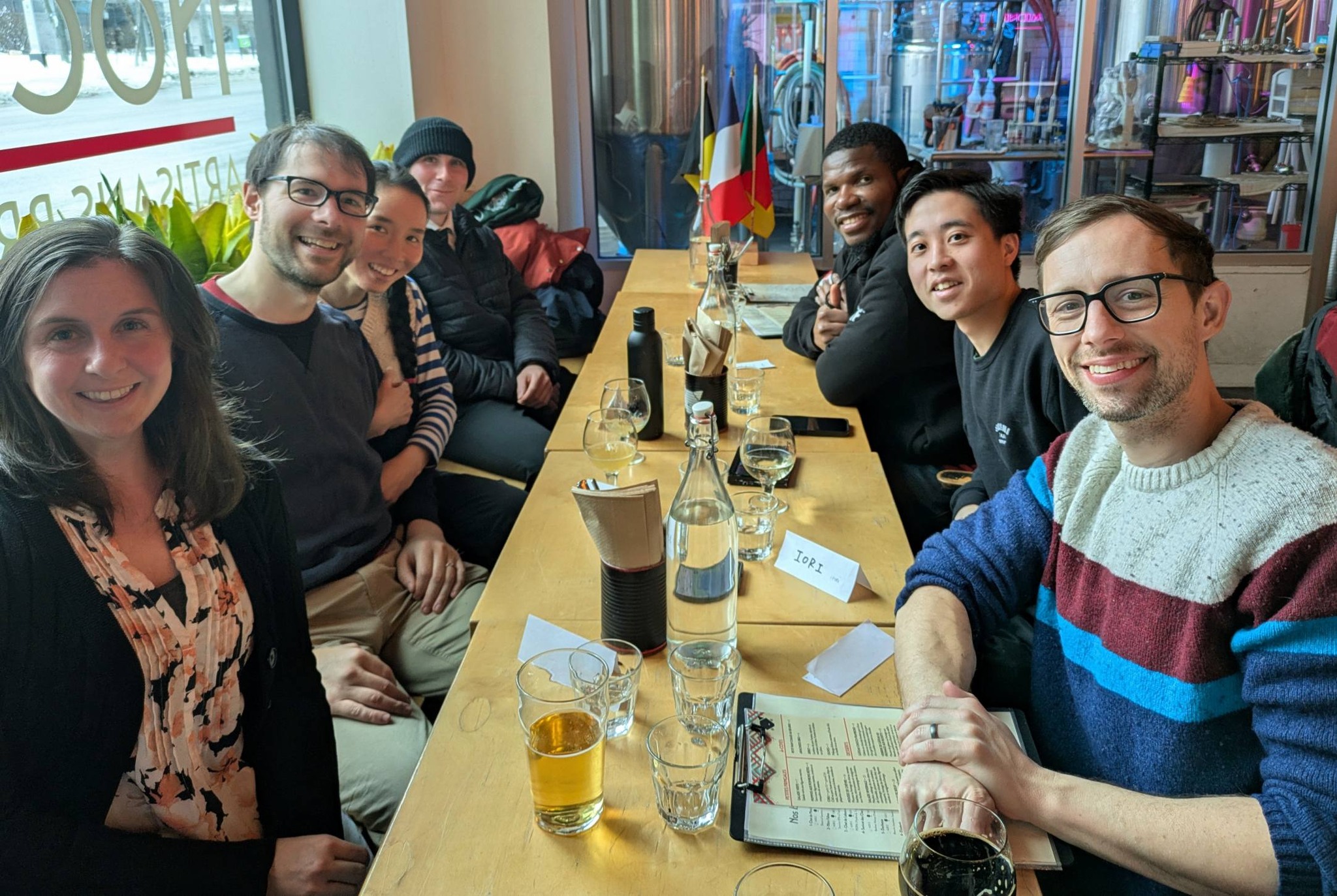
Learning another language is truly a challenge like no other! It’s all-encompassing and never-ending, and if you choose to learn a non-standard variety, like, say, Quebec French for example, it can sometimes feel like you’re learning two languages at once. For example, in class, I was taught words like “chaussure” (shoe) and “portable” (cellphone), but in the streets of Québec City, I hear “soulier” (shoe) and “cellulaire” (cellphone). Of course, I’m all for linguistic choice, but as a proud Quebec resident, I feel the need to learn, use, and share the dialect of my new home, so with that in mind, I give you a few of my favorite Quebecisms: 

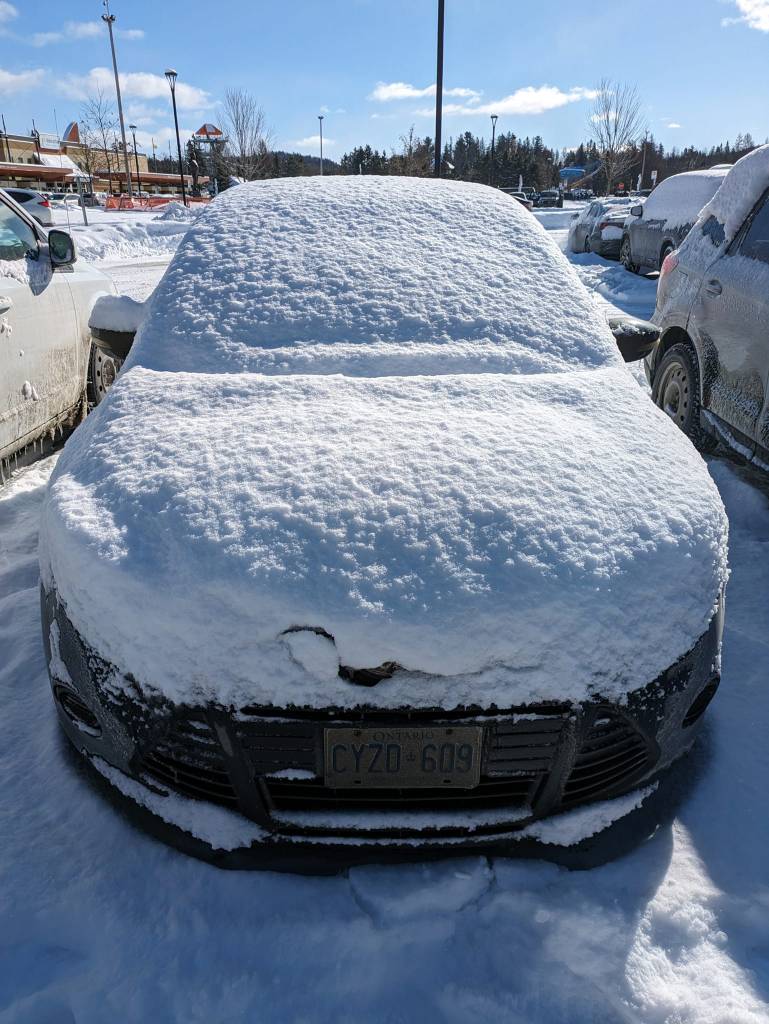
Notre char:)

Char

Standard French: voiture

English translation: car

First up is the use of “char” for “car”, and I know what you’re thinking, this has to be English influence at work, but no! “Char” was actually used in Old French to refer to chariots, horse-drawn carriages, two-wheeled carts, and the like. In Quebec, “char” happened to stick around, whereas in France people started using “voiture” for wheeled vehicles and “char” specifically for heavy-duty vehicles like tanks. I’ll be honest though, even our little Ford Focus feels a bit like a tank when busting through the snow banks of Québec City! Maybe it’s not such a big difference after all.

Blonde/chum

Standard French: copine/copain

English translation: girlfriend/boyfriend

Another Quebec classic is the use of “blonde” (regardless of actual hair color) and/or “chum” to refer to your significant other. I say “significant other” because most of the time they’re used for girlfriend/boyfriend, but there’s actually some flexibility there; your fiancé or even your husband could be “ton chum”. Of course, “chum” can also refer to just a friend (of any gender), which isn’t confusing at all, n’est-ce pas?

Très frette…

Il fait frette

Standard French: Il fait très froid

English translation: It’s really cold

Sometimes, necessity is the mother of invention, and in French Canada, the harsh climate has led to many inventions, including some of the linguistic sort. Here, we often experience stretches of -20° temperatures, where “cold” doesn’t quite cut it. So, when it’s Quebec cold aka really cold, we can say “il fait frette”, which means you had better be wearing multiple layers!

Sloche

Standard French: neige fondante

English translation: slush

In addition to the temperature differences between Canada and other Francophone countries, we tend to get a lot more snow over here, and like other snow-dwelling peoples, we need to be able to differentiate between the many different types of snow. Enter the word “sloche”, which refers to the nasty grey sludge that appears after the snow and ice start to melt. Known as “slush” in English, this one probably did come to Quebec via English influence, but the English actually got it from the Scandinavians, so it seems sloche is just a fact of life for all northerners!

Paparmane

Standard French: pastille de menthe

English translation: peppermint

Speaking of English influence, I think one of my favorite examples of phonetic borrowing might just be “paparmane”, which is how Quebecers nativized the English word “peppermint”. I love this for two reasons. For one, I’m always ecstatic when there’s a one-word alternative available in French (somewhat of a rarity!), but I also love it because it highlights just how different the respective orthographies are. If you could only see the way I’ve spelled some Quebec place names prior to seeing them written down… Oof! “Paparmane” is way closer than I ever get!

Jaser

Standard French: bavarder

English translation: to chat

“Jaser” is another Old French word that simply went out of favor in Europe, but is still hanging on in Canada. Here it just means “to chat”, but in France, “jaser” is associated with gossiping and has more of a negative connotation. Interestingly, the word used more commonly in France now is “bavarder”, which comes from a word that meant “saliva” or “drool”, which seems a bit negative in its own right, but what can I say? Language is compliquée.

Aweille

Standard French: allez

English translation: let’s go

“Aweille”, which I’ve also seen written as “enweille”, “awèye”, and even “enwoye” is a very useful Quebec creation for whenever I find myself trying to get my dog to hurry up and go pee already! It has such the perfect combination of sounds for whining, which is my preferred usage, but it can also be used in a more encouraging way like “Come on! Let’s go!” Aweille! There are more Quebec expressions to learn!   

Tiguidou

Standard French: parfait

English translation: okey dokey

Another super positive Québécois word is Tiguidou – positive and extremely fun to say, I might add! The origins of “tiguidou” are somewhat contested, but many believe it’s a borrowing from the British/Scottish expression “tickety-boo”, which honestly doesn’t help much for the Anglophones on this side of the Atlantic because what the heck is “tickety-boo”? Anyway, in Quebec, “tiguidou” is just a fun way to say “A-OK”. Et c’est tiguidou!  

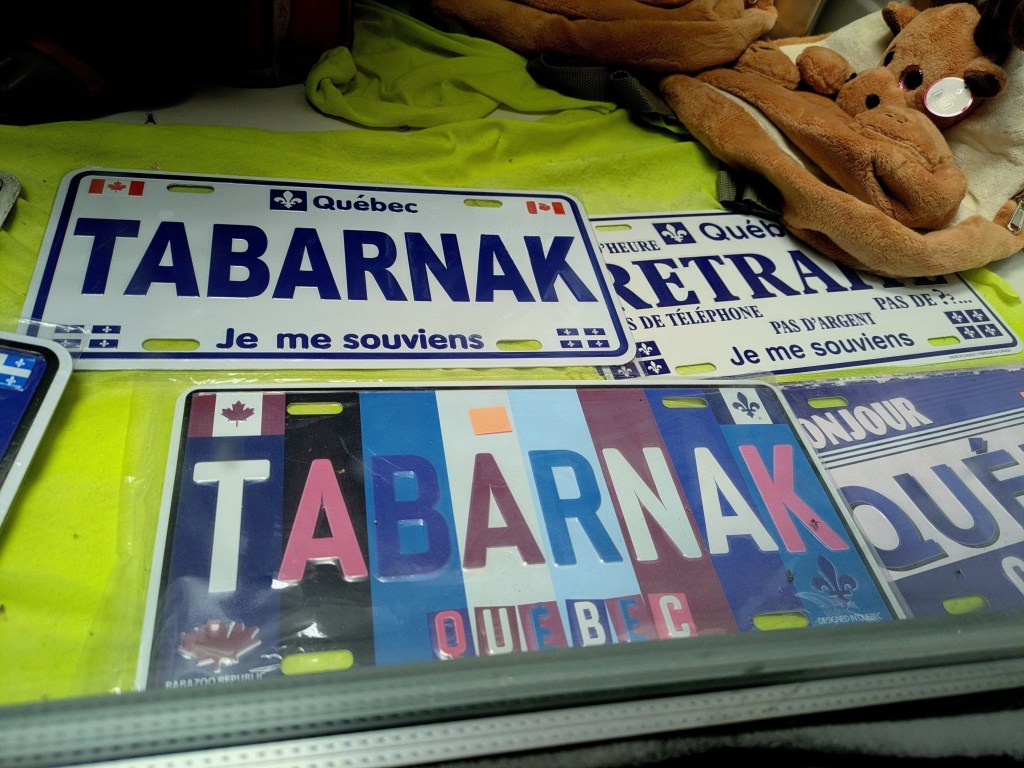
Tabarnak

Standard French: putain

English translation: holy shit

Of course, I can’t have a list of Quebecisms and not include the most famous of them all! A little warning though, if you’re not a fan of profanity, better skip to the next word because it’s impossible to talk about “Tabarnak” without swearing in multiple languages… To those still here, Quebec has a whole set of unique swear words that all have to do with the church, such as “Tabarnak” (which literally means “tabernacle”). Why is that a swear here? Good question! Unfortunately, this is the kind of thing that needs its own post entirely, so for now, you can just think of “Tabarnak” as a multifaceted, catch-all exclamation, not all that unlike the English “holy shit”! 

Attache ta tuque

Attache-la! Attache-la!

Standard French: accroche-toi

English translation: buckle up

Thankfully, I had already bolstered my Canadian vocabulary in Ottawa before relocating to Québec City, otherwise I might have been a little more confused upon first hearing “attache ta tuque”. Tuques are winter hats, so the phrase is literally saying “attach your winter hat”, but it’s used a lot like “buckle up”, as in, we’re in for something crazy here! Hang on your hats!  

Tire-toi une bûche

Standard French: installe-toi

English translation: pull up a chair

I love this expression because it just feels so…colonial. It literally means “pull up a log” as in find an unoccupied stump and have a seat. It’s so easy to imagine early settlers, sitting around a fire in a circle made up of nature’s chairs coining words like “tiguidou” and “paparmane”. There’s definitely an ease to modern-day Quebec culture as well, and I think that’s why a phrase like this still exists. Tire-toi une bûche and let’s just jaser the night away!  

L’affaire est ketchup

Standard French: c’est nickel

English translation: It’s all good

Last but not least, a phrase that I, as a ketchup-lover, just can’t get enough of! “L’affaire est ketchup” literally means something like “the thing is ketchup”, but it’s used as an idiom for “done deal” or “it’s all good”. The idea is that once the final touch of a little ketchup has been added, we’re all set; we’re good to go, which if you’ve ever seen me eat a hotdog, is a sentiment you know I take to heart!

So, there you have it! Just a few of the many colorful words and expressions that I’ve been learning as I strive to become one with La Belle Province! I hope you enjoyed them too! À la prochaine!

A Bit Different, Eh?

72198834_10220829312750933_5214555038575230976_n
Look how Canadian I am!

So we just spent our first month in Canada, and I can tell you I’ve never been more observant in all my life! Tucker and I are in the process of deciding where we want to live for the next few years, so we’ve been looking into everything from neighborhoods and public transportation options to social interactions and local habits, most recently in Ottawa and Montréal, Canada, but with a few cities in Mexico soon to follow (more about that in a subsequent post, I’m sure). Our reason behind these investigations is that neither of us have actually spent any real time in Canada (or Mexico), and we really just didn’t know what to expect. Would I find it too similar to the US (i.e. boring)? Would Tucker be able to get a job without speaking French or Spanish? What would our lives be like on the whole in any one of these places? To get a clearer picture, we first headed up to Ottawa and Montréal to see what we could discover about life in the Great White North. So far, these are a few things that have stood out to us as uniquely Canadian:

Language Uncertainty Dance

71894432_10220781349271876_8900321738064134144_n
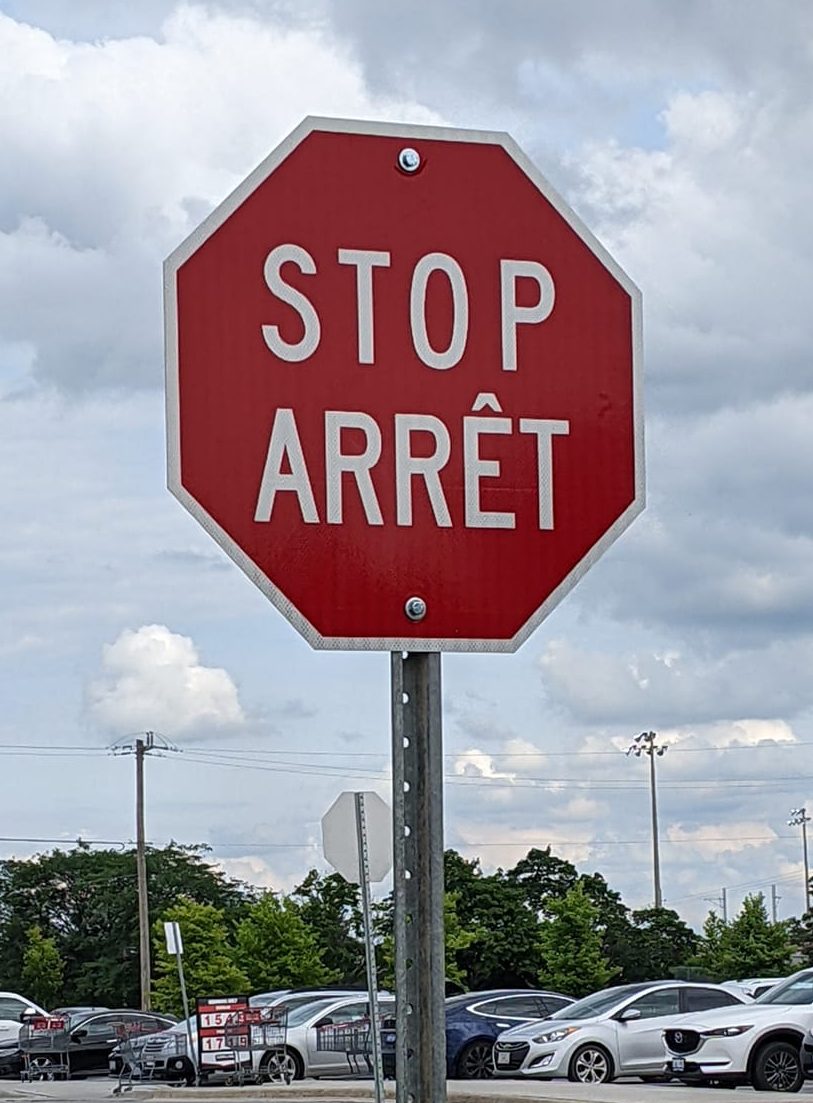
Aka “stop”

Many people know that Canada has two official languages, but what exactly does that look like? Well, to us it seems pretty clear cut on paper: in Québec, French is the default language, and everywhere else, English is the go-to. Therefore, signs, menus, and the like carefully follow provincial lines. However, people are bit more mobile than that, and the lines aren’t always so clear when speaking is involved. For example, Montréal is a very international city with immigrants who speak many different languages, and Ottawa is located half in Ontario and half in Québec. This all led to a bit of a which-language-should-we-use dance between us and everyone we encountered. Hotel staff, grocery store clerks, restaurant servers, and literally everyone we talked to had to make a choice of which language to use with us, and we, in turn, also had to choose.

We determined that provincial lines do play a role in the choice, but there were other factors of consideration as well, like the supposed heritage of the speaker (Francophone or Anglophone), how we appeared (clearly lost or in-the-know), and what situation were we in (ordering Vietnamese food or buying food from an outdoor market). Even our names seemed to be used as an indication; at all the ticket checkpoints I received “merci”s and Tucker got “thank you”s, and the only reason we could come up with is that my name is Danielle. For me, this process was fascinating, and I found myself eavesdropping on anyone and everyone just to note which language they were using and why. When so many people are bilingual the possibilities are truly much more interesting!

How Cold It Really Is

72737195_10220909004063166_1287696045052002304_n
Sometimes I wore my hat AND earmuffs…

Canada is quite far north, of course, but when looking at the lines of latitude, Ottawa and Montréal really aren’t that much above what I consider “normal” cities. Łódź, for example, is significantly closer to the Arctic Circle, which began a line of thought that led us severely astray. Because while the latitudes of these two cities are actually well below some well-known (and might I add, temperate) western counterparts like Vancouver or Seattle, their climates are simply different. There’s no large body of water to curb the freezing temperatures, and evidently the “Polar Vortex” is a real thing that starts much earlier than I had anticipated. In short, Ottawa is one of the top ten coldest national capitals in the world, and I didn’t bring my big jacket. Oopsies.

Honestly, even with my big jacket I doubt my small collection of outerwear is actually going to be enough for winter in Canada. Taking a look at some of the clothing stores here, we’ve seen winter gear we didn’t even know existed. Linings for boots, glove extensions, and every possible manner of covering your ears and face. The terminology is also a bit different, as I had to google the word “toque” shortly after our arrival. It’s actually pretty impressive to see the flexibility of clothing in action. Even in October, the temperatures can get below freezing, especially at night, but during the day it can get up to the 60’s. It’s amazing to watch the various pieces come off and go back on throughout the day, sometimes sparked solely because the sun came out from behind the clouds. I vaguely remember the vast temperatures swings of Chicago, but clearly I have yet to master dressing for them.

An Abundance of Animals

72753578_10220909004223170_1004007047059996672_n
Polite squirrels as well!

With our new-found knowledge of how cold and long “winter” in Canada can be, we definitely found the amount of fauna out and about to be rather odd. Immediately upon arrival to Ottawa (which I will remind you is 200kms from the closest Great Lake and almost 500kms away from the ocean) we were met with the loud, annoying cries of seagulls. Seagulls? There are no beaches here! Sure there are rivers, but it’s cold! What’s with the seagulls? In our first week we also came across squirrels of all colors, bunnies, chipmunks, and so so many birds. And that was in the city proper, skyscrapers well in view! It seems nature really is on your doorstep up here in the North. However, if I see a moose or a bear lumbering down Sparks Street, I might just lose my mind.

French/British Combo

IMG_6633
Her majesty

Another surprising insight into life in Canada is that it seems to be less of an American/French fusion and more of a British/French fusion. As a native inhabitant of a former British colony myself, I just assumed all former colonies were quite distinct from Old Blighty, but evidently there’s more of a scale of “Britishness” than I thought. Here in Canada, we have the Queen on the currency, a Prime Minister and Parliament, Celsius and the metric system, traditional tea and pub cultures, and the distinctive, yet eccentric spelling system with all those extra vowels and not enough “z”s. Additionally, as Americans, especially Americans coming from China, we’ve also found an extraordinary penchant for forming lines in Canada. At the train station we wrapped around the entire hall forming two lines to match the two platforms below the station. It seemed very odd to us, inefficient even, but soon we realized lines are a way of life here; basically if it’s a norm at Timmy’s, it’s a norm everywhere.

72112720_10220743900855689_5770965290108059648_n
Ah, Timmy’s

Interesting Fusions

72463415_10220908992302872_8469820978254315520_n
Beyond delicious!

Speaking of combos, we’ve also seen an incredible amount of interesting food fusions in Canada. Early on in our stay I ordered “pierogi eggrolls”, and even after eating them, I couldn’t quite wrap my head around the concept. Canada has seen its fair share of immigration throughout its history, and we can definitely see how that has affected the restaurants and their signature dishes throughout the country. We’ve had tandoori nachos, a turducken club, bruschetta mac and cheese, and many other colorful combinations. It seems even their own, native poutine (which is traditionally French fries covered in cheese curds and thick gravy) is also open to interpretation. We’ve tried jalapeño poutine, butter chicken poutine, and Peking duck poutine just to name a few! Stores and other vendors also seem to cater to this preference for food creativity and variety. We’ve seen ph broths and żurek mixes in grocery stores, Italian sausages served in French bread by street vendors, and vending machines with American, British, and European candy choices.

The Use of “Washroom”

This might be a small thing, but I couldn’t get over the Canadian use of the word “washroom”. I’ve lived in several different cities, on different continents even, thus I have heard many things used to describe the place we go to “relieve ourselves”. I’ve heard bathroom, restroom, toilet, WC, lavatory, powder room, even “the john”, but “washroom” is not one I would have listed as a common occurrence. Until Canada, that is. Here it’s virtually the only word they use! It’s on all the signs, it’s what people say, I was even corrected once when I asked about the location of the “restroom”. They looked a bit confused and clarified with, “the washroom?” Which I then went off in search of, quietly contemplating my accent, word choice, and place in the world.


73052411_10220861734961468_4555528384729317376_n
I bet they have the nicest washrooms in there.

Also of interest on the topic of washrooms in Canada is that they all seem to be located in the basement. At the majority of restaurants and pubs we visited, the washrooms were located under the establishment, often down a very long, steep staircase. I tried to look into why that is so common here, and the best I could find is that it had something to do with the building codes at the time of construction. Whatever the reason, I just hope they keep them well-heated in winter. Thankfully, even if the rooms themselves end up being a bit drafty, at least the hot water in Canada is on point. The tap water, we’ve noticed, goes from ice cold to absolutely steaming hot in about 5 seconds – in a pinch, I actually brewed my tea with the sink water in Montréal. Canada really does seem to love their extremes!

And, For Sure, the Politeness

71598087_10220781345631785_888126007620403200_n
We even got compliments on our photos!

Finally, the last Canadianism that stuck out to us was, indeed, the politeness that perhaps they are so well known for outside of Canada. At first, we noticed all the “no worries” and “of course”s and other pleasant responses to our many “thank you”s. There wasn’t even that tone of you’re-a-bit-of-an-idiot-and-I’m-only-helping-you-because-it’s-my-job sort of thing that’s so common Stateside. We also heard a lot of back channeling or the words you use when showing someone you’re paying attention. Things like “for sure, for sure”, “oh yeah, definitely”, and “wow, great”. There also seemed to be a great deal more small talk. People more frequently asked questions or shared information than what we have grown used to in the US. For example, when our bus cards didn’t work on the STO line, the bus driver took a few minutes to explain to us how the complicated inter-provincial system worked. He then let us ride for free – so nice! We’ve also been given quite a few tips for places to go and things to do, after various locals asked and discovered that we’re not Canadian. These politeness features have definitely made the big cities of Canada feel not quite as big.

71856286_10220743902535731_7367851035752136704_n
O Canada!

So these are some of the most obvious things that immediately reminded us that we’re not in the US; however, I have a feeling there will be many more discoveries like this in the future, should we come back for a longer stint. Every country, even long-time neighboring countries with similar back stories have their little quirks. I can’t wait to find out more about what makes Canada, Canada!