
One of the biggest challenges we face in trying to maintain this semi-nomadic lifestyle of ours is the constant job changes. It’s oddly something I don’t write about super often, but it is one of the questions I get asked most of all: “What do you do that allows you to live and move abroad over and over again?” Well, the truth is, we have done many things to make this happen, and this month, I’m going to share a little timeline of all the various jobs we’ve had over the years. Strap in because it’s a bit of a wild ride!
Pre-Expat Years (~2005-2015)

I suppose I have to start with the fact that we had no early plans to live and work abroad. During high school, I babysat, worked at Bruster’s Ice Cream, and moonlighted at a local dog kennel, and Tucker worked as a bag boy at Publix supermarket and delivered Chinese food on the side. Once we got into college, we started leaning towards pharmacy. At 18, we both got jobs as pharmacy technicians. Me, at Northside Pharmacy and later Rite-Aid Pharmacy, and Tucker, at CVS Pharmacy. Then I got into pharmacy school and subsequently had a bit of an existential crisis, so I did what any 20-year-old freaking out would do: I quit my job and dropped out of school.
That’s probably when I started realizing that A) I didn’t want to be tied down to any one place in particular, and B) I really enjoyed doing lots of different things. While I was shifting schools/majors, I worked as an online search guide (back when we didn’t have the internet on our phones), a telemarketer, a door-to-door salesperson, and a bank teller. But then, I started studying linguistics and absolutely fell in love, and coincidently, fell into the world of ESL (English as a Second Language). After finishing my degree, I started teaching at English for Internationals, and then I was fully hooked. I completed my master’s degree (also in applied linguistics) and worked for Georgia State University as a tutor, a research assistant, and a teaching assistant all while still teaching both in class and online for a few different institutions.

During all this, Tucker mostly worked at CVS Pharmacy, but when he graduated with his degree in biology, he got a job working for Castle Laboratories. At Castle, Tucker worked in the lab focusing on toxicology and drug testing, and he loved it, probably at least in part due to Castle’s super fun startup atmosphere. But I was starting to feel a bit stuck again. I was actually a little jealous of my students. I wanted to be completely immersed in a new language and culture like they were! The honeymoon trip we took to Finland and the one teach-abroad program I did in grad school had clearly not been enough for me. Cue Fulbright.
Poland (2015-2016)
Fulbright is an exchange program for students, teachers, scholars, and professionals, and it ended up being the perfect first step into living and working abroad. We had no idea what we were doing, but Fulbright helped us with everything from applying for our first visas to connecting us with mentors and other expats who gave us amazing advice right from the start. For a year, we lived in Łódź, Poland, and I taught several courses at the University of Łódź. Tucker did his best to work remotely for Castle, but after about 6 months, they ran into security issues, and he officially went on sabbatical.

Regardless of any challenges we faced in trying to stay semi-employed in the US while simultaneously spending a year abroad, it was pretty clear early on how much we both thrived living in a foreign country. We hadn’t ever been to Poland or had even heard of the city we now called home, but figuring everything out was a huge part of what we loved. It wasn’t long before I was making plans to stay in Poland even after my Fulbright contract was up. Unfortunately, we couldn’t really do that. At the time, we had no idea how to go about getting a visa or a work permit without Fulbright, and we also had about $40k in student loans to pay back in USD, which felt more like a ball and chain than I ever could have imagined.
Debt-Paying Year (2016-2017)
So, when my Fulbright contract ended, I was resigned to the fact that we’d have to go back to the States, but I now only had one goal in mind: pay off our debt and get back out there! And that’s exactly what we did. Tucker went back to work at Castle full-time, and I got a job teaching at Kennesaw State University. We also lived with family during this interim, ensuring that every cent we made went directly towards our student loan payments. In less than a year, we had zero debt, and we were just about ready to leave again, this time with no plans to come back. But how were we going to get our next visa? How about another exchange program?!
China (2017-2019)

And that’s how I became an English Language Fellow, or a TESOL specialist sent abroad to work on various academic projects that build community and mutual understanding between countries. With Fulbright, I had to choose a country to apply to, but this time, we were assigned to 1 of 70 participating countries. Our assignment: China, and I couldn’t wait! I actually still refer to Poland as our “first pancake” because while we did our best, we were really fumbling through every part of living and working abroad at that point. On our second trip out, I wanted to do better. This time we prepared like never before. We sold everything that didn’t come with us. Tucker had a program of his own to work on this time, and although we didn’t know how long we’d stay in China or what we’d do after ELF, I knew we’d being staying abroad.
We lived and worked in Hefei, China for two years. I taught several courses at Anhui University while also regularly traveling all around the country giving teacher-training workshops as part of the exchange program. Tucker completed an ASCP program and received his technologist of clinical chemistry certificate, and he also traveled with me, quickly becoming everyone’s go-to IT guy! Of course, whenever he got a little tired of university life, he would also spend time at a friend’s brewery helping with quality control and keeping his lab skills sharp. After our contract was finished, we also started working for a recording company in Hefei, reading for various English exams, which we are still doing almost a decade later! But eventually, we decided it was time to move on, and initially, we settled on Canada as our next stop because it had a lot of pros: it was drivable from the US, meaning we could take our pup; it was on the same continent as the rest of our family, and it was bilingual, which would be hugely beneficial for both our careers.

Pandemic Year (2020)

So, in the fall of 2019, we headed back to North America to spend some time with family before heading up to Canada. During this time, we checked out a few cities in Canada, interviewed for a few jobs, and submitted the last of our immigration paperwork, but after a few months, we still had some time left before we were meant to officially move in, so we also went down to Mexico to check out our Plan B. Turns out that was a really good move, because in couple of months the whole world had come to a halt, and we were beyond stuck.
By March 2020, I had a job training Canadian civil servants for their mandatory English exams, Tucker had a job working for a laboratory based in Florida, and we didn’t have a home in either of those countries. We had been bouncing around, waiting on our paperwork to process, but that was looking less and less likely due to the global shut down. After almost a year of sheltering in place (first with family and later in our pay-by-month bunker in downtown Orlando), we decided to enact Plan B and apply for temporary residencies in Mexico. Since both our jobs were online now anyway, por qué no? 6 weeks after applying, we found ourselves all packed up and driving down to Mexico.
Mexico (2021-2023)
Of course, the pandemic year was extremely tough on everyone, but I took it particularly badly since I had promised myself I wasn’t going to get stuck anywhere ever again. Hindsight, amiright? Well, thankfully, moving to Mexico was one of the best decisions we ever made. We were so happy to be immersed again, learning new things every day, and fully leaning into the digital nomads we had somehow become. In Mexico, I worked online for the Canadian training school and for Lingoda, another online school based in Berlin. Tucker, having been kicked out of the physical lab due to COVID, shifted to more of an IT role and was now processing data remotely for the lab back in Orlando. And so went a very tranquilo 2.5 years, until our paperwork for Canada finally went through.

Canada (2023-Present)

We first applied for our Canadian residency way back in October 2019, and at the time, it was projected to take 6 months. Well, with that pesky pandemic, it ended up taking 3 years. But the timing actually wasn’t too bad because while I had recently started working for Duolingo and was feeling even more confident working remotely, Tucker’s job at the lab in Orlando was on its last legs. So, we packed up the car again and drove all the way up to Ottawa. After just a few months, Tucker was able to land a job working firmly in the realm of IT. He’s now an implementation specialist for a company that provides software for laboratories. Due to immigration guidelines, we were restricted to certain provinces for the first few months, but we ended up staying in Ottawa for just about 2 years. However, Québec was the compromise we were truly after, and so in early 2025, we made Québec City our new home.
These days, Tucker is still working remotely for that same company based out of Ottawa, but as AI eventually pushed me out of Duolingo, I spent about a year working online as a tutor, an exam assessor, and a conference moderator before honing my French skills enough to get a job teaching at a local college here. Of course, I’m still too new to have a full course load, which is how I also came to get my tour guide license, adding yet one more job to my already ridiculously complex tax filings, but honestly, I wouldn’t have it any other way!


Future
So, what’s next? Will we eventually settle down? Will we run out of opportunities that continue to take us abroad? I hope not! I’m not sure I’m quite ready to officially settle down. As much as I love Québec, and I absolutely do! In fact, we’ll be applying for citizenship in the next couple of months because I never want paperwork to separate me from this particular home. But, at the same time, I am starting to feel the itch again. I think we have at least one more tour abroad left in us before we settle in again, perhaps for even longer next time. I’m personally still leaning towards Türkiye as our next locale, so if you know anyone there looking for a teacher or an IT specialist in the next couple of years, let me know! Until then, we’ll just keep collecting jobs, countries, and experiences because, somehow, they’ve all led us exactly where we needed to be.

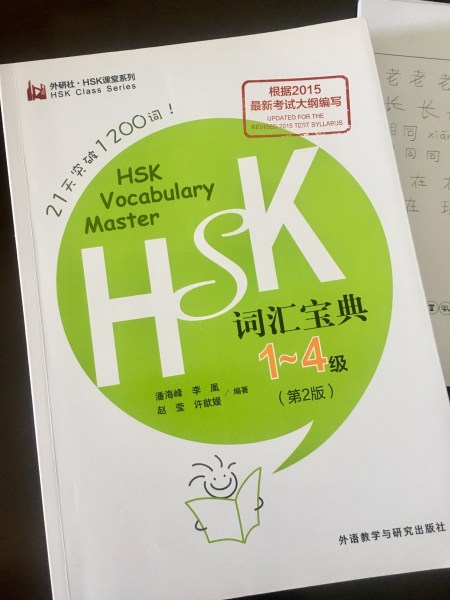 One of my goals this year, as I mentioned in my last post, is to really focus on my Mandarin skills. I’m planning to take the HSK before we leave next summer, and I’d really like to do well. The HSK is a Chinese proficiency test for foreigners learning the language. The highest score is a 6, which would demonstrate “a learner who can easily understand any information in Chinese and is capable of smoothly expressing themselves in written or oral form”. I’m aiming for a 3 (haha!), and since I’m likely going on this journey alone (Tucker really has no interest), I’d like to at least share a little bit about what makes Chinese such a difficult language to learn.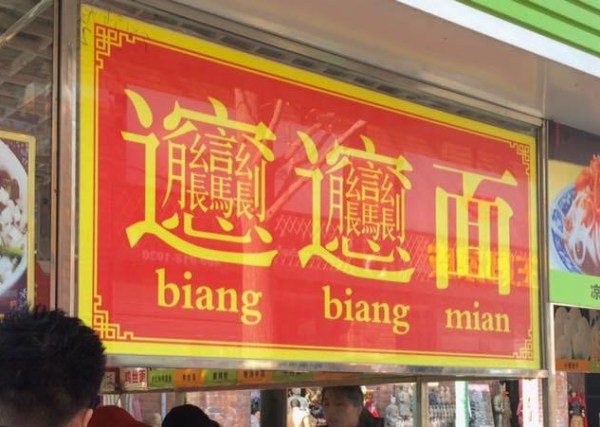

 Another problem we often encounter with pinyin is that it is more often than not missing the diacritic marks. Those marks represent the four tones of Mandarin, and are essential in its pronunciation. Unlike in English, changing the pitch of your voice while speaking Chinese can actually change the words you are saying. The pronunciation of mā (“mom”), má (“hemp”), mǎ (“horse”), and mà (“to scold”) only differs in tone. Unfortunately for lazy, toneless English speakers (like me), this makes it really hard for native Mandarin speakers to understand exactly what we’re saying. We try for “mom” and end up with “horse”, something which I hope has been more entertaining than irritating for them!
 Train = Fire + Car
 Alright now! Who’s ready to learn this with me?! Chinese is definitely a language on the rise as far as power and prestige go. Much like what happened to English in the 1700s, increases in immigration, tourism, and business are spreading Chinese to all parts of the globe. In Australia, I was surprised and delighted to find Mandarin on most signage, and, even in Georgia/Florida (quite far away from China), maps and other tourist information can often be found in Mandarin. Some linguists refer to Chinese as the language of the future, and while right now it’s more painfully in my present, I hope to keep it around for my future as well! Wish me luck!



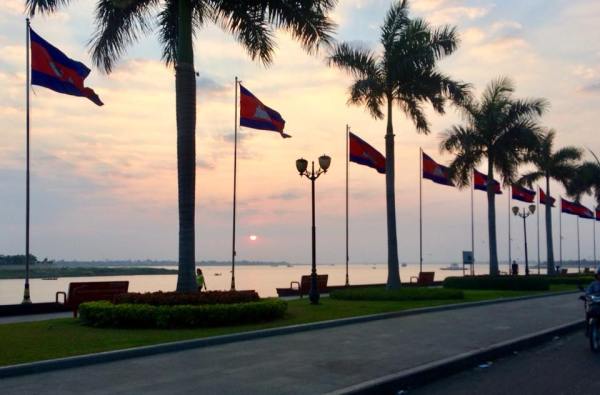

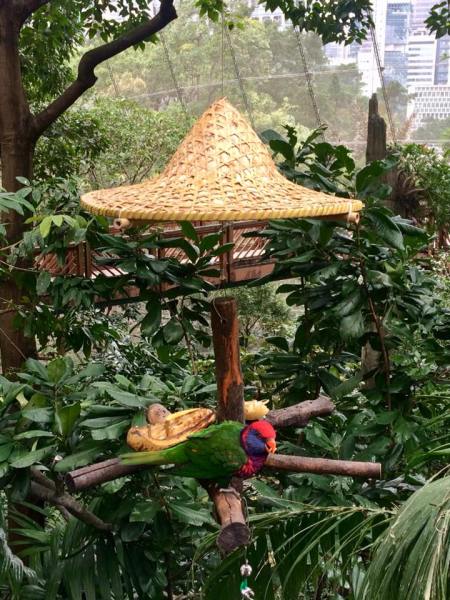


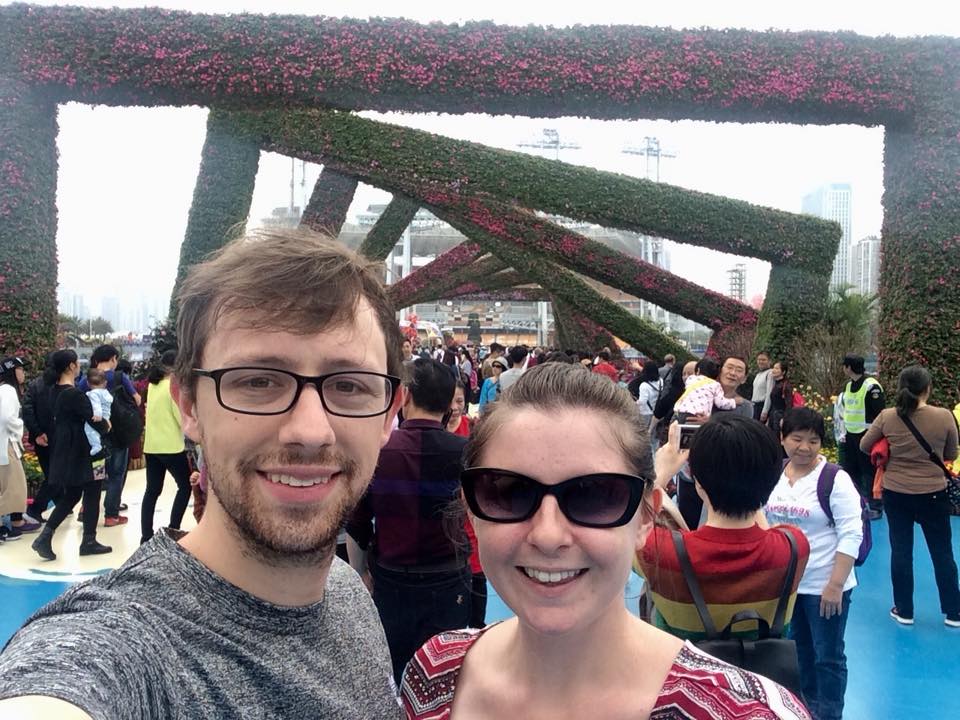
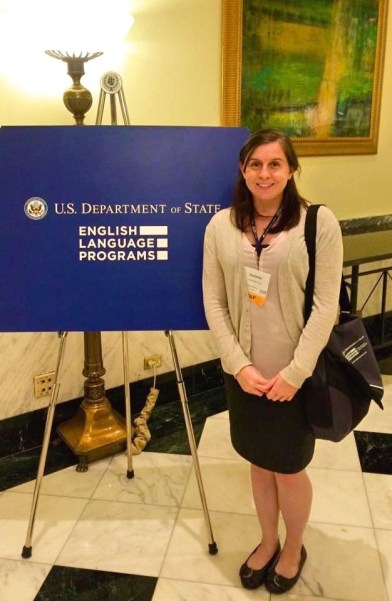 As always, time seems to be whizzing by, and somehow the halfway point of this year’s EL Fellow Program is only a few days away. For my region’s midyear meeting, we’ll be gathering in Thailand and reflecting, sharing, and discussing what we’ve all been doing these last 5 months. I can’t wait to hear about the other Fellows and their experiences, but I also wanted to take some time to write down some of my own. I did something similar when I was halfway through my Fulbright grant, and I was amazed at how it shaped my focus for the next semester. So here it is: my progress report.
 Teaching: The most familiar part of my job is the teaching. I teach English/Linguistics courses to third year English majors at Anhui University in Hefei, China. Their specializations run from linguistics and translation to literature and journalism, and they have a vast array of future goals and career paths in mind. I absolutely love spending time with them in class, hearing their candid thoughts about American culture and the English language as we discuss the challenges of public speaking and critical thinking. As a teacher at AHU, it’s also part of my job to attend and present at Linguistics-related conferences (like ELTAM’s TESOL Conference in Mongolia and the Teacher’s Development Conference in Wuhan). I’ve also been asked to participate as a coach, a judge, or even a “question master” for the various language competitions that the university and the country seem to love! This semester I’ve been involved with the English writing competition, the public speaking competition, and the American culture competition, just to name a few. Additionally, as a somewhat rare (in Hefei at least), native-speaking English teacher, I was invited to lead the university’s English Corner, which meets every other week. This is a chance for dedicated students wanting additional practice to meet up, play some games, and have general conversation in English. It’s also a place where I can ask all my cultural questions, have a little fun with the students, and at the end of the day, call it “work”!


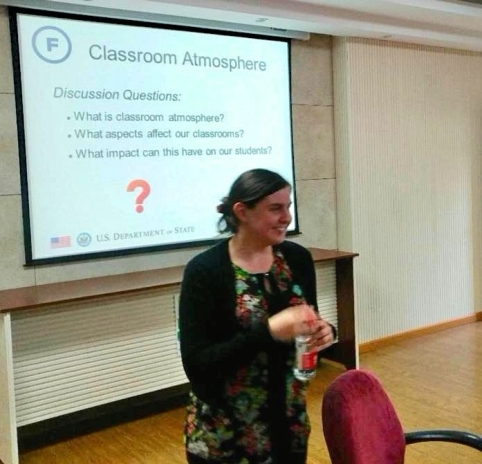 Teacher-Training: Another part of my job is teacher-training. Teachers in China are very interested in Western teaching styles, and are even more interested in teachers trained in Applied Linguistics (like me). For this reason, I usually have at least 1 or 2 visiting observers (usually other English teachers or graduate students) in my classes each week, taking notes on everything from the way I dress to the exact words that come out of my mouth. Luckily I have been able to observe a few of them in return, and we’re working together on blending the education styles of the two countries, as well as discussing concepts like classroom atmosphere and student-teacher roles. I’ve also been really active in facilitating online professional development courses/webinars for my colleagues. They’re extremely motivated teachers, but they don’t always have access to resources like that. Luckily the Fellow program (with the help of American English) provides them in spades. Workshops are another large part of my work here. At my host institution, my supervisor and I have set up monthly seminars where I, a visiting Fellow from another part of China, and occasionally local professors give presentations and workshops to the English department at AHU. I’ve also been able to travel to other universities in China to give these workshops and participate in their professional development activities. It has been a great way to meet new teachers, collaborate with other Fellows, and learn what life is like in other parts of China.


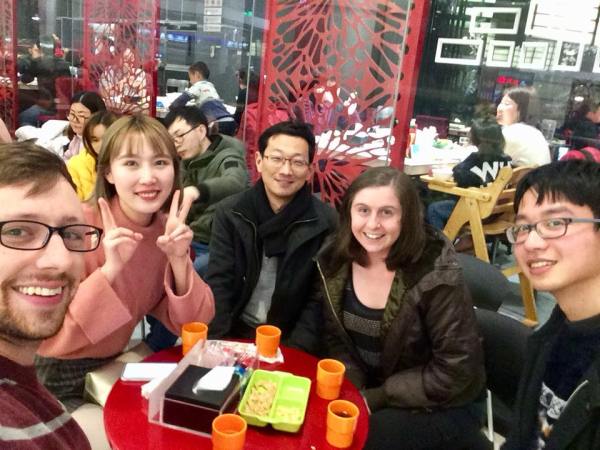 Cultural Exchange: Possibly my favorite part of being in a foreign country is the cultural exchange. Whether it’s through our traveling around the country or through our grocery store encounters, I never get bored of learning the little things about life in a new place. Tucker and I have been very fortunate in the amount of travel we’ve been able to do thus far in and around China. In the last five months we’ve visited Ulaanbaatar, Mongolia and the Chinese cities of Beijing, Nanjing, Shanghai, Wuhan, Huangshan, Xi’an, and Harbin. Some visits were for work, others for pleasure, but all were in the name of cultural exchange. We’ve met so many amazing new friends, seen some absolutely incredible things, and, of course, added to our growing knowledge of this country and its culture. I’m also doing my best to share my experiences (big and small) not only with my students, friends, and colleagues here, but also with anyone else who’s interested (even if it’s just my mom). I’ve become a “social media person”, posting consistently on Facebook, Twitter, Instagram, and WeChat (one of China’s biggest social media apps). I’ve also surprised myself by adding to this blog more than my previously dictated “once a month”. It turns out there is just so much I want to share about living in China! It’s also really fun to share what life was like for us in the US. My colleagues are interested so they can add cultural aspects to their classrooms, my students are interested so they can connect further with the language, and my friends are interested so they can understand why we are so weird about some things (for example, the fact that we enjoy drinking cold water even in winter – weirdos!).


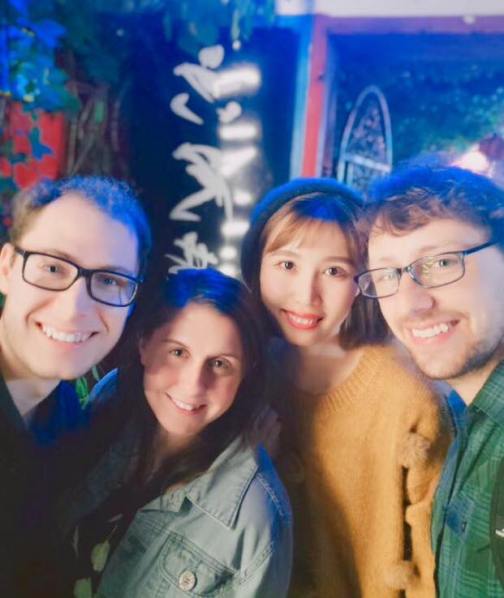 Expat Life: The last element of my time as an English Language Fellow in China has to be my experience of living the expat life. I decided quite a while ago that the expat life is the life for me, but now in my second year of actually living it, I decided to fully embrace the lifestyle. I’ve joined several expat groups here in Hefei and have met some amazing people that share so much in common with me and Tucker. We’ve had game nights, beer tastings, and other adventures that are made all the more fun by our shared experience of being the “outsiders” here. It’s amazing how quickly groups of expats become like family! Recently I’ve also become a “Warden”, which sounds like a bad thing, but it’s actually sort of a go-between for the US Consulates and any Americans living abroad. Of course, to me another important part of expat life is learning to blend in. Honestly, it’s a bit harder here than it was in Poland, but regardless, Tucker and I are studying Chinese and doing our best to live like locals. We buy our non-perishables from Taobao, we use WeChat or Alipay to pay for everything, and we’ve even been known to yell for the servers (fuwuyuan!) when needed. It’s been an incredibly exciting five months, full of new opportunities, unforgettable experiences, funny situations, personal developments, and so much more. I can’t wait to see what the next half will bring!


